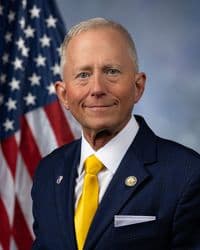


Jefferson Van Drew

Jefferson Van Drew

Republican · U.S. Representative for New Jersey's 2nd district

58 sponsored · 459 cosponsored

Age 73 · In office since 2019

Contact their office: (202) 225-6572 · 2447 Rayburn House Office Building, Washington, DC 20515 · Official website

What they got done

Most bills never get a vote. These are the ones they wrote or backed that got somewhere.

Became law (6)

  • John Joyce (R-PA)

    Cosponsored

    Choices for Increased Mobility Act of 2026

    H.R. 1703 Health

    A Republican bill with 4 Democratic cosponsors.

    Became law

    This bill amends title XVIII of the Social Security Act to clear up payment rules for manual wheelchairs under Medicare Part B.

    Yes· 2 of 6

    • Scored +3

      Does this expand the rights of people with disabilities?

      The bill addresses specific needs for ultralightweight manual wheelchairs which are essential for mobility and independence.

    • Scored +2

      Would people over 65 be better off under this?

      The bill clarifies Medicare coverage rules for specialized wheelchairs which benefits older adults relying on Medicare Part B.

    The opposite

    • Scored -3

      Would households on low incomes be better off under this?

      The bill allows suppliers to charge individuals the difference between the Medicare payment and the actual cost, which could create financial burdens.

    • Scored -2

      Does this lower what people pay out of pocket for care, such as deductibles, copays and surprise bills?

      The bill allows suppliers to charge individuals the difference between the actual charge and the Medicare payment amount.


  • Mike Quigley (D-IL)

    Cosponsored

    Accelerating Access to Critical Therapies for ALS Reauthorization Act of 2026

    H.R. 8205 Health

    A Democratic bill with 39 Republican cosponsors.

    Became law

    This bill extends the provisions and grants for ALS research found in the original Act through fiscal year 2031.

    Yes· 2 of 3

    • Scored +7

      Does this put more money into medical research?

      The bill extends the authorization of grants for ALS research through fiscal year 2031.

    • Scored +6

      Would people with disabilities be better off under this?

      The bill promotes research into therapies for ALS, a debilitating neurodegenerative disease.

    No question was scored the opposite.

  • Brian Mast (R-FL)

    Cosponsored

    Medal of Sacrifice Act

    H.R. 3497 Crime and Law Enforcement

    A Republican bill with 9 Democratic cosponsors.

    Became law

    This bill establishes a medal to honor law enforcement officers and first responders who were killed in the line of duty.

    Yes· 2 of 7

    • Scored +1

      Would people in cities be better off under this?

      The bill honors law enforcement and first responders who serve various jurisdictions.

    • Scored +1

      Would veterans be better off under this, taking everything together?

      The bill honors the service and sacrifice of first responders and law enforcement personnel.

    The opposite

    • Scored -1

      Does this change how police departments operate?

      The bill requires a Commission to investigate the circumstances of death and eligibility based on findings of wrongdoing.

And 3 more on their Sponsored and Cosponsored pages.

Passed one chamber, waiting on the other (39)

Halfway: the other chamber has to pass the same text before it can go to the President.

  • Jefferson Van Drew (R-NJ)

    Their bill

    PROOF Act

    H.R. 10326 Government Operations and Politics

    A Republican bill with no cosponsors. See the voting map.

    Passed the House

    217207

    Now: handed to a committee to examine — Committee on the Judiciary · Sep 17

    This bill requires the head of a State administering certain programs to provide information to the Attorney General upon receiving a written request.

    Yes· 2 of 8

    • Scored +6

      Does this give the federal government more power?

      Mandates that state heads provide information requested by the federal Attorney General.

    • Scored +5

      Does this make the government pay for what it commits to?

      Increases oversight and accountability for the distribution of federal funds to states.

    The opposite· 2 of 4

    • Scored -5

      Does this leave more decisions to the states?

      Reduces state autonomy over the management and disclosure of their own program data.

    • Scored -3

      Does this protect people from being watched or searched?

      Allows federal access to identity and demographic records, potentially infringing on individual privacy.

  • Gus Bilirakis (R-FL)

    Cosponsored

    Major Richard Star Act

    H.R. 2102 Armed Forces and National Security

    A Republican bill with 207 Democratic cosponsors. See the voting map.

    Passed the House

    39218

    Now: handed to a committee to examine — Committee on Armed Services · Nov 12

    This bill changes the rules to allow certain military retirees to receive both veterans' disability compensation and retired pay at the same time.

    Yes· 2 of 3

    • Scored +8

      Would veterans be better off under this, taking everything together?

      This bill provides significant financial relief to veterans with combat-related disabilities by allowing them to receive both retired pay and disability compensation concurrently.

    • Scored +7

      Does this increase the pay, pensions or support veterans receive?

      The bill increases financial benefits for veterans with combat-related disabilities by allowing concurrent receipt of retired pay and disability compensation.

    No question was scored the opposite.

  • Gabe Evans (R-CO)

    Cosponsored

    Ratepayer Protection Act

    H.R. 9340 Energy

    A Republican bill with 7 Democratic cosponsors. See the voting map.

    Passed the House

    4173

    This bill amends the Public Utility Regulatory Policies Act of 1978 to create a new Federal standard regarding the costs of upgrades for large-load customers.

    Yes· 2 of 5

    • Scored +7

      Does this keep data centers from raising household electric and water bills?

      The bill requires large-load customers to cover the full incremental cost of grid upgrades and provide financial assurances, preventing those costs from being passed to households.

    • Scored +5

      Does this give people more protection from unfair business practices?

      The bill protects general ratepayers by ensuring large-load entities cover their own infrastructure costs.

    The opposite· 2 of 4

    • Scored -5

      Would business owners be better off under this?

      Large-scale non-residential energy consumers face increased costs and financial assurance requirements.

    • Scored -3

      Does this make it easier to build data centers and the power supply for them?

      The bill imposes new financial obligations and requirements for financial assurances that may act as a hurdle to data center development.

And 36 more on their Sponsored and Cosponsored pages.

Resolutions of theirs that were adopted (1)

A resolution is a chamber speaking for itself — a position, a rule or a tribute. Adopting it puts it into effect, but it is not a law.

Still waiting, of the 58 bills they wrote: 56 are in committee. Committee is where most bills end, whoever writes them — silence there, not a vote, is the usual way a bill dies.

What their bills would do

Every bill is scored against plain yes-or-no questions. These count their bills — the ones they wrote and the ones they cosponsored — by how each question was answered: yes, or the opposite. Open one to see those bills, where each stands, and why it was scored that way. Scores are made by AI ().

Who their bills would affect

What else they would change

How they voted lately

Their latest votes that decided something, and what each measure would do.

  • U.S. House · Nov 12, 2026

    Major Richard Star Act

    The vote on whether to pass the bill This is the real decision in this chamber. Passing here sends the bill to the other chamber, which must pass it too before it can go to the President.

    Their vote Yea

    This bill changes the rules to allow certain military retirees to receive both veterans' disability compensation and retired pay at the same time.

    • Scored +8

      Would veterans be better off under this, taking everything together?

      This bill provides significant financial relief to veterans with combat-related disabilities by allowing them to receive both retired pay and disability compensation concurrently.

  • U.S. House · Nov 12, 2026

    Providing for consideration of the bill (H.R. 2102) to amend title 10, United States Code, to provide for concurrent receipt of veterans' disability compensation and retired pay for disability retirees with combat-related disabilities, and for other purposes.

    The vote on whether to adopt the resolution A resolution is one chamber speaking for itself — setting its own rules, taking a position, honouring someone — and it never goes to the President. Agreeing to it is the whole decision.

    Their vote Yea

    H. Res. 1247 sets the rules for how the House of Representatives will consider the bill H.R. 2102, which is also known as the "Major Richard Star Act."

    • Scored +7

      Would people with disabilities be better off under this?

      The bill provides increased financial compensation for service-connected disabilities.

  • U.S. House · Nov 11, 2026

    Retirement Fairness for Charities and Educational Institutions Act of 2025

    The vote on whether to pass the bill This is the real decision in this chamber. Passing here sends the bill to the other chamber, which must pass it too before it can go to the President.

    Their vote Yea

    This bill amends Federal securities laws to enhance 403(b) retirement plans. The changes affect laws such as the Investment Company Act of 1940, the Securities Act of 1933, and the Securities Exchange Act of 1934.

    • Scored +5

      Does this give people more protection from unfair business practices?

      The bill enhances consumer protection by establishing fiduciary responsibilities for employers managing 403(b) investment options.

Every vote they cast, and how often they missed one →

On the President’s vetoes

A vetoed bill becomes law only if two-thirds of both chambers pass it again. The President can refuse to sign a bill both chambers passed. It becomes law anyway only if two-thirds of the House and two-thirds of the Senate vote to pass it again. A vote against the veto (a Yea) was a vote to make the bill law over the President’s objection; a vote for it (a Nay) was a vote to let the veto stand.

How busy they have been

How many bills they have put their name to over time — volume, not results: most bills never get a vote.

Legislative activity over time