
A Republican bill with 7 Democratic cosponsors · See all 42 cosponsors
Last activity — Motion to proceed to consideration of measure withdrawn in Senate. (CR S5199)
Passed one chamber, waiting for the other to take it up
Passed one chamber, and the other has not yet sent it to a committee or put it on its calendar.
The other chamber will hand it to a committee, place it on its calendar, or leave it where it is. Nothing has been decided, and a bill can sit here indefinitely.
Its path through Congress
- Introduced
- Passed House 417–3
- Awaiting Senate
What this bill would do
This bill is known as the Ratepayer Protection Act. It amends the Public Utility Regulatory Policies Act of 1978 to create a new Federal standard regarding the costs of upgrades for large-load customers. Specifically, it targets non-residential electric consumers that use energy for information technology infrastructure like data storage with a peak demand of 100 megawatts or more. The bill requires that utility rates for these large-load customers cover the full, incremental cost of any necessary upgrades. It also requires these customers to provide financial assurances or contributions before upgrades are made. Additionally, State regulatory authorities and nonregulated electric utilities must consider and make a determination regarding this new standard within specific timeframes.
Yes· 3 of 4
- Scored +5
Does this give people more protection from unfair business practices?
The bill protects general ratepayers by ensuring large-load entities cover their own infrastructure costs.
- Scored +5
Does this give the federal government more power?
The bill establishes a new federal standard for utility rate recovery and cost-sharing.
- Scored +4
Would households on low incomes be better off under this?
Reduces the burden on general ratepayers by requiring large users to pay for their own upgrades.
The opposite
- Scored -5
Would business owners be better off under this?
Large-scale non-residential energy consumers face increased costs and financial assurance requirements.
- Scored -3
Does this put more rules on large technology companies?
The bill imposes new cost-recovery obligations on massive IT infrastructure operators.
- Scored -2
Does this leave more decisions to the states?
The bill imposes federal mandates on state regulatory authorities.
What Congress actually voted on
2 recorded votes have been taken on this bill.
- The House: a fast-track vote, needing two-thirds to pass The House sets aside its normal procedure to move quickly: no amendments, little debate, and a two-thirds bar instead of a simple majority. It is used for measures expected to be uncontroversial, so a bill that fails here failed despite broad expectations that it would not. Passed 417 yes · 3 no
09/16/2026 · Roll call 312 · recorded as “On Motion to Suspend the Rules and Pass, as Amended”
- The Senate: a vote to end debate and allow a final vote In the Senate, debate can continue indefinitely unless 60 senators vote to end it. This vote is that attempt. It decides whether the Senate may vote on the thing at all — not whether the thing passes. A failed cloture vote usually ends the matter without anyone ever voting on its merits. Blocked 57 yes · 43 no
09/30/2026 · Roll call 254 · recorded as “On Cloture on the Motion to Proceed H.R. 9340”
Who it would affect, and how
Potential Positive Impacts for People
-
Section 2 (Section 111(d)(22)(A)): This provision requires that electric rates for large-load customers are designed to recover the full, incremental cost of any generation, transmission, or distribution upgrades needed to serve them. This might be considered positive because it applies even if the large-load customer terminates their contract or stops purchasing electric energy.
-
Section 2 (Section 111(d)(22)(B)): This provision mandates that electric utilities require large-load customers to provide financial assurances or contributions to cover upgrade costs before any necessary upgrades are made. This might be considered positive because it secures funds upfront for the utility's infrastructure changes.
-
Section 2 (Section 112(b)(9)): This provision requires State regulatory authorities and nonregulated electric utilities to commence consideration of the new standard within 1 year and complete it within 2 years. This might be considered positive because it sets a clear timeline for officials to review and act on the matter.
Potential Negative Impacts for People
- Section 2 (Section 112(b)(9)): The text does not explicitly identify negative consequences or burdens for individuals or groups of people within the United States resulting from this section or the bill as a whole.
Groups and Interests Ranking
Every group the model scored this bill for, from -10 to +10. Tap or hover a score for the reason it gave.
- Economy And Finance
- Does this give people more protection from unfair business practices? — The bill protects general ratepayers by ensuring large-load entities cover their own infrastructure costs.
- Demographic And Interest Groups
- Would households on low incomes be better off under this? — Reduces the burden on general ratepayers by requiring large users to pay for their own upgrades. Would middle-income households be better off under this? — Provides financial relief by shifting infrastructure costs to large-scale energy consumers. Would business owners be better off under this? — Large-scale non-residential energy consumers face increased costs and financial assurance requirements.
- Education And Technology
- Does this put more rules on large technology companies? — The bill imposes new cost-recovery obligations on massive IT infrastructure operators.
- Governance And Ideology
- Does this give the federal government more power? — The bill establishes a new federal standard for utility rate recovery and cost-sharing. Does this leave more decisions to the states? — The bill imposes federal mandates on state regulatory authorities.
In the queue for a floor vote, with no date set
No amendments submitted yet for this bill.
- 9/30/2026
- Motion to proceed to consideration of measure made in Senate. (CR S5199)
- Cloture on the motion to proceed to the measure not invoked in Senate by Yea-Nay Vote. 57 - 43. Record Vote Number: 254.
- Motion to proceed to consideration of measure withdrawn in Senate. (CR S5199)
- 9/29/2026
- Motion to proceed to consideration of measure made in Senate.
- 9/28/2026
- Motion to proceed to consideration of measure made in Senate. (CR S5065)
- Cloture motion on the motion to proceed to the measure presented in Senate. (CR S5065)
- 9/24/2026
- Read the second time. Placed on Senate Legislative Calendar under General Orders. Calendar No. 684.
- 9/23/2026
- Read the first time. Placed on Senate Legislative Calendar under Read the First Time.
- 9/17/2026
- Received in the Senate.
- 9/16/2026
- Motion to reconsider laid on the table Agreed to without objection.
- Passed/agreed to in House: On motion to suspend the rules and pass the bill, as amended Agreed to by the Yeas and Nays: (2/3 required): 417 - 3 (Roll no. 312). (text: CR H5656-5657)
- On motion to suspend the rules and pass the bill, as amended Agreed to by the Yeas and Nays: (2/3 required): 417 - 3 (Roll no. 312). (text: CR H5656-5657)
- Considered as unfinished business. (consideration: CR H5958-5959)
- 9/15/2026
- At the conclusion of debate, the Yeas and Nays were demanded and ordered. Pursuant to the provisions of clause 8, rule XX, the Chair announced that further proceedings on the motion would be postponed.
- DEBATE - The House proceeded with forty minutes of debate on H.R. 9340.
- Considered under suspension of the rules. (consideration: CR H5656-5661)
- Mr. Guthrie moved to suspend the rules and pass the bill, as amended.
- 9/10/2026
- Reported (Amended) by the Committee on Energy and Commerce. H. Rept. 119-814.
- Placed on the Union Calendar, Calendar No. 713.
- 7 Cosponsors added.
- 9/4/2026
- 1 Cosponsor added.
- 9/2/2026
- 3 Cosponsors added.
- 9/1/2026
- 2 Cosponsors added.
- 8/31/2026
- 4 Cosponsors added.
- 8/27/2026
- 6 Cosponsors added.
- 8/17/2026
- 2 Cosponsors added.
- 8/3/2026
- 2 Cosponsors added.
- 7/27/2026
- 1 Cosponsor added.
- 7/23/2026
- 1 Cosponsor added.
- 7/21/2026
- Committee Consideration and Mark-up Session Held
- Ordered to be Reported in the Nature of a Substitute by the Yeas and Nays: 52 - 0.
- 1 Cosponsor added.
- 7/20/2026
- Committee Consideration and Mark-up Session Held
- 4 Cosponsors added.
- 7/13/2026
- 1 Cosponsor added.
- 6/30/2026
- 2 Cosponsors added.
- 6/29/2026
- 2 Cosponsors added.
- 6/25/2026
- 1 Cosponsor added.
- 6/24/2026
- Subcommittee Consideration and Mark-up Session Held
- Forwarded by Subcommittee to Full Committee by Voice Vote.
- 6/23/2026
- 1 Cosponsor added.
- 6/18/2026
- Referred to the House Committee on Energy and Commerce.
- Referred to the Subcommittee on Energy.
- 1 Cosponsor added.
- Introduced in House
2 bills Congress.gov lists as related to this one — companions in the other chamber, earlier versions, and bills this one absorbed or was folded into.
 Sanford Bishop
Democrat · Georgia
 Lauren Boebert
Republican · Colorado
 Tom Barrett
Republican · Michigan
 Michael Baumgartner
Republican · Washington
 Henry Cuellar
Democrat · Texas
 Kathy Castor
Democrat · Florida
 Earl Carter
Republican · Georgia
 Ben Cline
Republican · Virginia
 Jeff Crank
Republican · Colorado
 Monica De La Cruz
Republican · Texas
 Pat Fallon
Republican · Texas
 Brian Fitzpatrick
Republican · Pennsylvania
 Mike Flood
Republican · Nebraska
 Brad Finstad
Republican · Minnesota
 Clay Fuller
Republican · Georgia
 H. Griffith
Republican · Virginia
 Josh Gottheimer
Democrat · New Jersey
 Maggie Goodlander
Democrat · New Hampshire
 Bill Huizenga
Republican · Michigan
 Harriet Hageman
Republican · Wyoming
 Jeff Hurd
Republican · Colorado
 Jim Jordan
Republican · Ohio
 John Joyce
Republican · Pennsylvania
 Thomas Kean
Republican · New Jersey
 Jennifer Kiggans
Republican · Virginia
 Laurel Lee
Republican · Florida
 Michael Lawler
Republican · New York
 Michael McCaul
Republican · Texas
 John Moolenaar
Republican · Michigan
 Jennifer McClellan
Democrat · Virginia
 Ryan Mackenzie
Republican · Pennsylvania
 Riley Moore
Republican · West Virginia
 Kristen McDonald Rivet
Democrat · Michigan
 John McGuire
Republican · Virginia
 Robert Onder
Republican · Missouri
 Christopher Smith
Republican · New Jersey
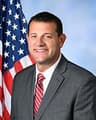 David Valadao
Republican · California
 Jefferson Van Drew
Republican · New Jersey
 Beth Van Duyne
Republican · Texas
 Derrick Van Orden
Republican · Wisconsin
 Robert Wittman
Republican · Virginia
 Randy Weber
Republican · Texas