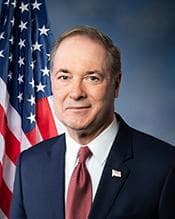

John Joyce

John Joyce

Republican · U.S. Representative for Pennsylvania's 13th district

26 sponsored · 153 cosponsored

Age 69 · In office since 2019

Contact their office: (202) 225-2431 · 2102 Rayburn House Office Building, Washington, DC 20515 · Official website

What they got done

Most bills never get a vote. These are the ones they wrote or backed that got somewhere.

Became law (7)

  • John Joyce (R-PA)

    Their bill

    Choices for Increased Mobility Act of 2026

    H.R. 1703 Health

    A Republican bill with 4 Democratic cosponsors.

    Became law

    This bill amends title XVIII of the Social Security Act to clear up payment rules for manual wheelchairs under Medicare Part B.

    Yes· 2 of 6

    • Scored +3

      Does this expand the rights of people with disabilities?

      The bill addresses specific needs for ultralightweight manual wheelchairs which are essential for mobility and independence.

    • Scored +2

      Would people over 65 be better off under this?

      The bill clarifies Medicare coverage rules for specialized wheelchairs which benefits older adults relying on Medicare Part B.

    The opposite

    • Scored -3

      Would households on low incomes be better off under this?

      The bill allows suppliers to charge individuals the difference between the Medicare payment and the actual cost, which could create financial burdens.

    • Scored -2

      Does this lower what people pay out of pocket for care, such as deductibles, copays and surprise bills?

      The bill allows suppliers to charge individuals the difference between the actual charge and the Medicare payment amount.


  • John Joyce (R-PA)

    Their bill

    Providing congressional disapproval under chapter 8 of title 5, United States Code, of the rule submitted by the Environmental Protection Agency relating to "California State Motor Vehicle and Engine Pollution Control Standards; Advanced Clean Cars II; Waiver of Preemption; Notice of Decision".

    H.J.Res. 88 Environmental Protection

    A Republican resolution with 41 Republican cosponsors. See the voting map.

    Became law

    The Senate voted 51–44 on May 22.

    This joint resolution expresses congressional disapproval of a specific rule submitted by the Environmental Protection Agency.

    Yes

    • Scored +5

      Does this leave more decisions to the states?

      By striking the EPA rule, Congress supports the ability of states like California to set their own stricter standards without federal interference.

    • Scored +3

      Would business owners be better off under this?

      Automotive manufacturers may benefit from the reduction in stricter regulatory requirements for vehicle emissions.

    The opposite· 2 of 6

    • Scored -5

      Does this better protect air, water and wildlife?

      The resolution undermines environmental standards set by the EPA for motor vehicle emissions.

    • Scored -5

      Does this cut the pollution that drives climate change?

      Stripping the EPA rule reduces the regulatory pressure to transition to cleaner vehicle standards, potentially slowing carbon emission reductions.

  • Pete Stauber (R-MN)

    Cosponsored

    Miracle on Ice Congressional Gold Medal Act

    H.R. 452 Sports and Recreation

    A Republican bill with 107 Democratic cosponsors.

    Became law

    This Act authorizes the award of 3 Congressional Gold Medals to the members of the 1980 U.S. Olympic Men's Ice Hockey Team. The medals recognize the team's victory over the Soviet Union during the 1980 Winter Olympics.

    Yes

    • Scored +1

      Is this likely to grow the economy?

      The sale of duplicate bronze medals provides a small influx of revenue to the United States Mint Public Enterprise Fund.

    No question was scored the opposite.

And 4 more on their Sponsored and Cosponsored pages.

Passed one chamber, waiting on the other (24)

Halfway: the other chamber has to pass the same text before it can go to the President.

  • John Joyce (R-PA)

    Their bill

    RED Tape Act

    H.R. 6398 Environmental Protection

    A Republican bill with no cosponsors. See the voting map.

    Passed the House

    222205

    Now: handed to a committee to examine — Committee on Environment and Public Works · Apr 17

    This Act seeks to amend the Clean Air Act. It specifically targets the review process conducted by the Environmental Protection Agency regarding proposed legislation.

    Yes

    • Scored +2

      Would business owners be better off under this?

      The bill potentially benefits business owners by reducing the regulatory review processes for federal projects and agency actions.

    • Scored +2

      Does this make it easier to run a small business?

      By limiting the scope of EPA reviews on federal projects and regulations, the bill aims to reduce regulatory burdens on business activities.

    The opposite· 2 of 3

    • Scored -4

      Does this better protect air, water and wildlife?

      The bill reduces environmental protections by stripping the EPA's authority to review newly authorized federal construction projects and proposed agency regulations under the Clean Air Act.

    • Scored -3

      Does this give the federal government more power?

      The bill reduces the oversight power of the federal EPA Administrator over agency actions and federal construction projects.

  • Gabe Evans (R-CO)

    Cosponsored

    Ratepayer Protection Act

    H.R. 9340 Energy

    A Republican bill with 7 Democratic cosponsors. See the voting map.

    Passed the House

    4173

    This bill amends the Public Utility Regulatory Policies Act of 1978 to create a new Federal standard regarding the costs of upgrades for large-load customers.

    Yes· 2 of 5

    • Scored +7

      Does this keep data centers from raising household electric and water bills?

      The bill requires large-load customers to cover the full incremental cost of grid upgrades and provide financial assurances, preventing those costs from being passed to households.

    • Scored +5

      Does this give people more protection from unfair business practices?

      The bill protects general ratepayers by ensuring large-load entities cover their own infrastructure costs.

    The opposite· 2 of 4

    • Scored -5

      Would business owners be better off under this?

      Large-scale non-residential energy consumers face increased costs and financial assurance requirements.

    • Scored -3

      Does this make it easier to build data centers and the power supply for them?

      The bill imposes new financial obligations and requirements for financial assurances that may act as a hurdle to data center development.

  • Troy Balderson (R-OH)

    Cosponsored

    Load Forecasting Enhancement Act

    H.R. 9332 Energy

    A Republican bill with 3 Democratic cosponsors.

    Passed the House

    By voice vote, no names recorded

    Now: handed to a committee to examine — Committee on Energy and Natural Resources · Sep 16

    This bill requires the Federal Energy Regulatory Commission to set up regional joint boards made up of state representatives and a commission member.

    Yes· 2 of 18

    • Scored +4

      Does this make what the government does easier for the public to see?

      Explicitly mandates the improvement of transparency and accuracy of data used for electric load forecasting.

    • Scored +3

      Would business owners be better off under this?

      More reliable and affordable energy supports business operations.

    The opposite

    • Scored -1

      Does this leave more decisions to the states?

      Requires state regulatory authorities to consider federally established forecasting standards.

And 21 more on their Sponsored and Cosponsored pages.

Still waiting, of the 26 bills they wrote: 23 are in committee. Committee is where most bills end, whoever writes them — silence there, not a vote, is the usual way a bill dies.

What their bills would do

Every bill is scored against plain yes-or-no questions. These count their bills — the ones they wrote and the ones they cosponsored — by how each question was answered: yes, or the opposite. Open one to see those bills, where each stands, and why it was scored that way. Scores are made by AI ().

Who their bills would affect

What else they would change

How they voted lately

Their latest votes that decided something, and what each measure would do.

  • U.S. House · Nov 12, 2026

    Major Richard Star Act

    The vote on whether to pass the bill This is the real decision in this chamber. Passing here sends the bill to the other chamber, which must pass it too before it can go to the President.

    Their vote Yea

    This bill changes the rules to allow certain military retirees to receive both veterans' disability compensation and retired pay at the same time.

    • Scored +8

      Would veterans be better off under this, taking everything together?

      This bill provides significant financial relief to veterans with combat-related disabilities by allowing them to receive both retired pay and disability compensation concurrently.

  • U.S. House · Nov 12, 2026

    Providing for consideration of the bill (H.R. 2102) to amend title 10, United States Code, to provide for concurrent receipt of veterans' disability compensation and retired pay for disability retirees with combat-related disabilities, and for other purposes.

    The vote on whether to adopt the resolution A resolution is one chamber speaking for itself — setting its own rules, taking a position, honouring someone — and it never goes to the President. Agreeing to it is the whole decision.

    Their vote Nay

    H. Res. 1247 sets the rules for how the House of Representatives will consider the bill H.R. 2102, which is also known as the "Major Richard Star Act."

    • Scored +7

      Would people with disabilities be better off under this?

      The bill provides increased financial compensation for service-connected disabilities.

  • U.S. House · Nov 11, 2026

    Retirement Fairness for Charities and Educational Institutions Act of 2025

    The vote on whether to pass the bill This is the real decision in this chamber. Passing here sends the bill to the other chamber, which must pass it too before it can go to the President.

    Their vote Yea

    This bill amends Federal securities laws to enhance 403(b) retirement plans. The changes affect laws such as the Investment Company Act of 1940, the Securities Act of 1933, and the Securities Exchange Act of 1934.

    • Scored +5

      Does this give people more protection from unfair business practices?

      The bill enhances consumer protection by establishing fiduciary responsibilities for employers managing 403(b) investment options.

Every vote they cast, and how often they missed one →

On the President’s vetoes

A vetoed bill becomes law only if two-thirds of both chambers pass it again. The President can refuse to sign a bill both chambers passed. It becomes law anyway only if two-thirds of the House and two-thirds of the Senate vote to pass it again. A vote against the veto (a Yea) was a vote to make the bill law over the President’s objection; a vote for it (a Nay) was a vote to let the veto stand.

How busy they have been

How many bills they have put their name to over time — volume, not results: most bills never get a vote.

Legislative activity over time