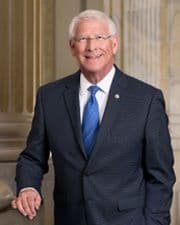

Roger F. Wicker

Roger F. Wicker

Republican · U.S. Senator for Mississippi

46 sponsored · 304 cosponsored

Age 75 · In office since 2007, in Congress since 1995

Contact their office: (202) 224-6253 · 425 Russell Senate Office Building, Washington, DC 20510 · Official website

What they got done

Most bills never get a vote. These are the ones they wrote or backed that got somewhere.

Became law (7)

  • Roger Wicker (R-MS)

    Their bill

    A bill to waive the 60-day notice requirement for the posthumous honorary promotion of Captain Cody Khork, United States Army.

    S. 4138 Armed Forces and National Security

    A Republican bill with 1 Democratic cosponsor.

    Became law

    This bill is an act to waive a specific notice requirement. It specifically addresses the 60-day notice required under title 10 of the United States Code.

    Yes

    • Scored +5

      Would veterans be better off under this, taking everything together?

      The bill provides a symbolic honor to a fallen member of the United States Army.

    • Scored +5

      Does this increase the pay, pensions or support veterans receive?

      The bill honors a deceased service member through a posthumous promotion to the rank of major.

    No question was scored the opposite.

  • Ted Cruz (R-TX)

    Cosponsored

    Illegal Red Snapper and Tuna Enforcement Act

    S. 283 Public Lands and Natural Resources

    A Republican bill with 1 Democratic cosponsor.

    Became law

    This legislation requires specific agency leaders to develop a standard methodology based on chemical analysis to identify the country of origin of seafood.

    Yes· 2 of 8

    • Scored +7

      Does this better protect air, water and wildlife?

      Directly combats illegal fishing which helps prevent overfishing and protects marine ecosystems.

    • Scored +5

      Does this strengthen ties with allied countries?

      Authorizes technical assistance and collaboration with other nations to combat illegal fishing and organized crime.

    No question was scored the opposite.

  • Mike Crapo (R-ID)

    Cosponsored

    Secure Rural Schools Reauthorization Act of 2025

    S. 356 Public Lands and Natural Resources

    A Republican bill with 16 Democratic cosponsors. See the voting map.

    Became law

    The House voted 399–5 on Dec 9.

    This bill aims to extend the Secure Rural Schools and Community Self-Determination Act of 2000. It extends various deadlines and years within the original act, such as changing certain dates from 2023 to 2026.

    Yes· 2 of 7

    • Scored +5

      Would people in rural areas be better off under this?

      The bill directly extends financial payments and project authority to rural counties containing federal land.

    • Scored +5

      Does this invest in rural communities?

      The bill explicitly extends funding and authority for counties with federal lands to support their local development and special projects.

    No question was scored the opposite.

And 4 more on their Sponsored and Cosponsored pages.

Passed one chamber, waiting on the other (11)

Halfway: the other chamber has to pass the same text before it can go to the President.

  • Roger Wicker (R-MS)

    Their bill

    USMMA Athletics Act of 2026

    S. 3266 Transportation and Public Works

    A Republican bill with 1 Democratic cosponsor.

    Passed the Senate

    With no one objecting, no names recorded

    Now: kept ready for the floor instead of being sent to a committee · Aug 10

    This bill aims to support the athletic programs of the United States Merchant Marine Academy. It authorizes the Secretary of Transportation to establish a nonprofit corporation to serve these athletic programs.

  • Roger Wicker (R-MS)

    Their bill

    A bill to make technical corrections to the National Defense Authorization Act for Fiscal Year 2026.

    S. 4164 Congress

    A Republican bill with 1 Democratic cosponsor.

    Passed the Senate

    With no one objecting, no names recorded

    Now: kept ready for the floor instead of being sent to a committee · Mar 24

    This bill is designed to make technical corrections to the National Defense Authorization Act for Fiscal Year 2026. It addresses specific qualifications required for Judge Advocates regarding their legal license status.

    Yes

    • Scored +5

      Would veterans be better off under this, taking everything together?

      The amendment regarding the Distinguished-service Cross honors the valor of a veteran by correcting the award heading.

    • Scored +5

      Does this increase the pay, pensions or support veterans receive?

      The bill removes the word 'posthumous' from the heading of the award for Isaac 'Ike' Camacho's acts of valor.

    No question was scored the opposite.

  • Roger Wicker (R-MS)

    Their bill

    National Defense Authorization Act for Fiscal Year 2026

    S. 2296 Armed Forces and National Security

    A Republican bill with no cosponsors. See the voting map.

    Passed the Senate

    The Senate voted 77–20 on Oct 10.

    77–20

    Now: kept ready for the floor instead of being sent to a committee · Nov 12

    This legislation authorizes funding and personnel for the Department of Defense, the Department of Energy's national security activities, and military construction for fiscal year 2026.

    Yes· 2 of 84

    • Scored +10

      Would households on low incomes be better off under this?

      Extensive focus on affordable housing, rental assistance, food assistance, and targeted disaster recovery grants.

    • Scored +10

      Does this make housing cost less?

      Comprehensive expansion of modular housing, rental assistance, and attainable housing for low-to-moderate income families.

    The opposite· 2 of 10

    • Scored -10

      Does this reduce what is spent on the military?

      Massively increases spending on nuclear deterrence, procurement, and intelligence activities.

    • Scored -8

      Would LGBTQ people be better off under this?

      Prohibits funding for sex change surgeries and repeals pronoun identification requirements.

And 8 more on their Sponsored and Cosponsored pages.

Resolutions of theirs that were adopted (5)

A resolution is a chamber speaking for itself — a position, a rule or a tribute. Adopting it puts it into effect, but it is not a law.

Still waiting, of the 46 bills they wrote: 3 cleared committee and wait for a first vote, 34 are in committee. Committee is where most bills end, whoever writes them — silence there, not a vote, is the usual way a bill dies.

What their bills would do

Every bill is scored against plain yes-or-no questions. These count their bills — the ones they wrote and the ones they cosponsored — by how each question was answered: yes, or the opposite. Open one to see those bills, where each stands, and why it was scored that way. Scores are made by AI ().

Who their bills would affect

What else they would change

How they voted lately

Their latest votes that decided something, and what each measure would do.

  • U.S. Senate · Sep 29, 2026

    Protect College Sports Act of 2026

    The vote on whether to pass the bill This is the real decision in this chamber. Passing here sends the bill to the other chamber, which must pass it too before it can go to the President.

    Their vote Yea

    This bill sets national rules for student athlete name, image, and likeness rights. It creates protections for academic progress, medical coverage, and health and safety standards.

    • Scored +9

      Would people in their twenties and thirties be better off under this?

      Significantly expands earning potential through NIL rights and provides medical and academic protections for college athletes.

    • Scored -5

      Does this leave more decisions to the states?

      Prevents states from enforcing their own NIL compensation and transfer laws that conflict with the federal framework.

  • U.S. Senate · Sep 29, 2026

    To increase the limitation on funding for post-eligibility insurance and catastrophic injury for student athletes.

    A vote on a proposed change to the bill A vote on one change, not on the bill. A bill can collect dozens of these, and losing one does not stop it.

    Their vote Nay

    What the Amendment Does Mr. Booker, along with Mr. Blumenthal, submitted this amendment to change how a specific fund or program is paid for in the bill.

Every vote they cast, and how often they missed one →

On the President’s nominees

The President chooses federal judges, cabinet secretaries, ambassadors and military officers, and the Senate decides whether each one gets the job. Most are confirmed by voice vote, which records no one’s position. In the 119th Congress (2025–2026) the Senate put 224 confirmations to a recorded vote, and confirmed every one.

Their votes to confirm, of 224 recorded votes

  • Yes: 211
  • No: None
  • Missed: 13

Those votes covered 581 nominees, because the Senate sometimes confirms many in a single vote.

How busy they have been

How many bills they have put their name to over time — volume, not results: most bills never get a vote.

Legislative activity over time