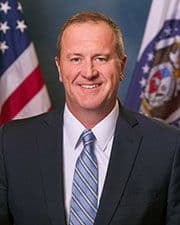
Eric Schmitt

Eric Schmitt

Republican · U.S. Senator for Missouri

61 sponsored · 173 cosponsored

Age 51 · In office since 2023

Contact their office: (202) 224-5721 · 404 Russell Senate Office Building, Washington, DC 20510 · Official website

What they got done

Most bills never get a vote. These are the ones they wrote or backed that got somewhere.

Became law (3)

  • John Cornyn (R-TX)

    Cosponsored

    Holocaust Expropriated Art Recovery Act of 2025

    S. 1884 Law

    A Republican bill with 11 Democratic cosponsors.

    Became law

    This Act seeks to clarify and improve the existing 2016 Act. It aims to ensure that claims to recover Nazi-looted art are resolved on their actual merits rather than being dismissed due to various legal technicalities.

    Yes

    • Scored +7

      Does this protect the right to fair treatment by the courts?

      The bill enhances legal recourse for victims by precluding time-based and discretionary defenses.

    No question was scored the opposite.

  • Bill Cassidy (R-LA)

    Cosponsored

    HALT Fentanyl Act

    S. 331 Crime and Law Enforcement

    A Republican bill with 6 Democratic cosponsors. See the voting map.

    Became law

    The House voted 321–104 on Jun 12.

    This bill permanently places all fentanyl-related substances into schedule I of the Controlled Substances Act.

    Yes· 2 of 9

    • Scored +6

      Does this do more about addiction and overdose deaths?

      The act directly attempts to combat the fentanyl crisis by increasing penalties and attempting to decrease availablity.

    • Scored +3

      Does this put more money into scientific research?

      Streamlining research registration may indirectly incentivize funding for scientific research related to fentanyl and other schedule I substances.

    The opposite· 2 of 10

    • Scored -3

      Does this shorten or soften prison sentences?

      Increased penalties for fentanyl-related substances could lead to longer prison sentences, hindering criminal sentencing reform efforts.

    • Scored -2

      Would households on low incomes be better off under this?

      Increased penalties could disproportionately affect low-income households due to the higher likelihood of being involved in the criminal justice system.

  • Katie Britt (R-AL)

    Cosponsored

    Laken Riley Act

    S. 5 Immigration

    A Republican bill with 2 Democratic cosponsors. See the voting map.

    Became law

    The House voted 263–156 on Jan 22.

    This legislation requires the Secretary of Homeland Security to take certain inadmissible aliens into custody if they are charged with, arrested for, convicted of, or admit to committing burglary, theft, larceny, shopli…

    Yes· 2 of 5

    • Scored +3

      Does this tighten control of the border?

      The bill emphasizes the detention of aliens charged with theft, potentially contributing to increased border security efforts.

    • Scored +2

      Does this leave more decisions to the states?

      Grants State Attorneys General the power to sue the federal government, increasing state power relative to the federal government.

    The opposite· 2 of 7

    • Scored -5

      Would immigrants be better off under this?

      The bill negatively impacts immigrants facing charges, as it mandates their detention.

    • Scored -3

      Does this make it easier for immigrants already here to become citizens?

      By mandating detention for certain offenses, the bill could reduce opportunities for some immigrants to pursue a pathway to citizenship.

Passed one chamber (12)

Halfway: the other chamber has to pass the same text before it can go to the President. One of these was stopped after it passed.

  • Eric Schmitt (R-MO)

    Their bill

    National Plan for Epilepsy Act

    S. 494 Health

    A Republican bill with 19 Democratic cosponsors.

    Passed the Senate

    With no one objecting, no names recorded

    Now: kept ready for the floor instead of being sent to a committee · Aug 10

    This bill directs the Secretary of Health and Human Services to review and update existing Federal programs related to epilepsy. This review covers research, prevention, early identification, diagnosis, and treatment.

    Yes· 2 of 4

    • Scored +5

      Would people with disabilities be better off under this?

      The bill focuses on improving diagnosis, treatment, and quality of life for those with epilepsy, a disabling condition.

    • Scored +5

      Does this expand the rights of people with disabilities?

      The bill aims to improve health outcomes, functionality, and quality of life for people living with epilepsy.

    No question was scored the opposite.

  • Eric Schmitt (R-MO)

    Their bill

    Declaration of Independence Reaffirmation Act of 2026

    S. 4828 Government Operations and Politics

    A Republican bill with no cosponsors.

    Passed the Senate

    With no one objecting, no names recorded

    Now: kept ready for the floor instead of being sent to a committee · Jun 23

    This bill seeks to reaffirm the Declaration of Independence as an Organic Law of the United States.

    Yes· 2 of 24

    • Scored +3

      Does this protect the right to vote?

      Reaffirms the principle of government by the consent of the governed.

    • Scored +2

      Would LGBTQ people be better off under this?

      Reaffirms the principle of equal citizenship and natural rights.

    The opposite

    • Scored -2

      Does this give the federal government more power?

      Reaffirms that public officers are servants to the sovereign people.

  • Ted Cruz (R-TX)

    Cosponsored

    Route 66 National Historic Trail Designation Act

    S. 2887 Public Lands and Natural Resources

    A Republican bill with 4 Democratic cosponsors.

    Passed the Senate

    With no one objecting, no names recorded

    This bill amends the National Trails System Act to officially designate the Route 66 National Historic Trail.

    Yes· 2 of 10

    • Scored +3

      Would business owners be better off under this?

      Business owners along Route 66 benefit from the increased visibility and tourism that comes with the official designation.

    • Scored +3

      Would people in rural areas be better off under this?

      Provides economic opportunities via tourism while protecting rural property rights and energy interests.

    No question was scored the opposite.
And 9 more on their Sponsored and Cosponsored pages.

Resolutions of theirs that were adopted (9)

A resolution is a chamber speaking for itself — a position, a rule or a tribute. Adopting it puts it into effect, but it is not a law.

Still waiting, of the 61 bills they wrote: 6 cleared committee and wait for a first vote, 44 are in committee. Committee is where most bills end, whoever writes them — silence there, not a vote, is the usual way a bill dies.

What their bills would do

Every bill is scored against plain yes-or-no questions. These count their bills — the ones they wrote and the ones they cosponsored — by how each question was answered: yes, or the opposite. Open one to see those bills, where each stands, and why it was scored that way. Scores are made by AI ().

Who their bills would affect

What else they would change

How they voted lately

Their latest votes that decided something, and what each measure would do.

  • U.S. Senate · Sep 29, 2026

    Protect College Sports Act of 2026

    The vote on whether to pass the bill This is the real decision in this chamber. Passing here sends the bill to the other chamber, which must pass it too before it can go to the President.

    Their vote Yea

    This bill sets national rules for student athlete name, image, and likeness rights. It creates protections for academic progress, medical coverage, and health and safety standards.

    • Scored +9

      Would people in their twenties and thirties be better off under this?

      Significantly expands earning potential through NIL rights and provides medical and academic protections for college athletes.

    • Scored -5

      Does this leave more decisions to the states?

      Prevents states from enforcing their own NIL compensation and transfer laws that conflict with the federal framework.

  • U.S. Senate · Sep 29, 2026

    To increase the limitation on funding for post-eligibility insurance and catastrophic injury for student athletes.

    A vote on a proposed change to the bill A vote on one change, not on the bill. A bill can collect dozens of these, and losing one does not stop it.

    Their vote Nay

    What the Amendment Does Mr. Booker, along with Mr. Blumenthal, submitted this amendment to change how a specific fund or program is paid for in the bill.

Every vote they cast, and how often they missed one →

On the President’s nominees

The President chooses federal judges, cabinet secretaries, ambassadors and military officers, and the Senate decides whether each one gets the job. Most are confirmed by voice vote, which records no one’s position. In the 119th Congress (2025–2026) the Senate put 224 confirmations to a recorded vote, and confirmed every one.

Their votes to confirm, of 224 recorded votes

  • Yes: 223
  • No: None
  • Missed: 1

Those votes covered 593 nominees, because the Senate sometimes confirms many in a single vote.

How busy they have been

How many bills they have put their name to over time — volume, not results: most bills never get a vote.

Legislative activity over time