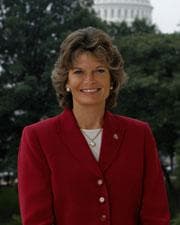


Lisa Murkowski

Lisa Murkowski

Republican · U.S. Senator for Alaska

61 sponsored · 248 cosponsored

Age 69 · In office since 2002

Contact their office: (202) 224-6665 · 522 Hart Senate Office Building, Washington, DC 20510 · Official website

What they got done

Most bills never get a vote. These are the ones they wrote or backed that got somewhere.

Became law (6)

  • Dan Sullivan (R-AK)

    Cosponsored

    ARTIST Act

    S. 254 Native Americans

    A Republican bill with 1 Republican cosponsor. See the voting map.

    Became law

    The House voted 404–14 on Jun 3.

    This bill aims to amend the Marine Mammal Protection Act of 1972.

    Yes· 2 of 11

    • Scored +7

      Would Native Americans be better off under this?

      The bill specifically protects the cultural practices and economic livelihoods of Alaska Natives.

    • Scored +5

      Does this narrow racial gaps in how people are treated?

      The bill protects the cultural traditions and economic livelihoods of Alaska Native populations.

    The opposite

    • Scored -3

      Does this leave more decisions to the states?

      The bill explicitly prohibits States from banning or restricting the trade of these specific items.

    • Scored -2

      Does this better protect air, water and wildlife?

      The bill creates exemptions for taking marine mammals, which may impact species protection if not strictly regulated.


  • Steve Daines (R-MT)

    Cosponsored

    A bill to require the Federal Energy Regulatory Commission to extend the time period during which licensees are required to commence construction of certain hydropower projects.

    S. 1020 Energy

    A Republican bill with 1 Democratic cosponsor. See the voting map.

    Became law

    The House voted 394–14 on Apr 21.

    This bill directs the Federal Energy Regulatory Commission to extend the timeframe for starting construction on certain hydropower projects.

    Yes· 2 of 6

    • Scored +5

      Would business owners be better off under this?

      The bill benefits energy company owners by providing more time to commence construction and a mechanism to reinstate expired licenses.

    • Scored +3

      Is this likely to create jobs?

      The extension of construction timelines provides more time for hydropower projects to proceed, which may eventually create construction and operational jobs.

    The opposite

    • Scored -2

      Does this better protect air, water and wildlife?

      By extending construction timelines for older hydropower projects, the bill may delay the transition to newer environmental standards or mitigate the impact of older infrastructure.

  • Mike Crapo (R-ID)

    Cosponsored

    Secure Rural Schools Reauthorization Act of 2025

    S. 356 Public Lands and Natural Resources

    A Republican bill with 16 Democratic cosponsors. See the voting map.

    Became law

    The House voted 399–5 on Dec 9.

    This bill aims to extend the Secure Rural Schools and Community Self-Determination Act of 2000. It extends various deadlines and years within the original act, such as changing certain dates from 2023 to 2026.

    Yes· 2 of 7

    • Scored +5

      Would people in rural areas be better off under this?

      The bill directly extends financial payments and project authority to rural counties containing federal land.

    • Scored +5

      Does this invest in rural communities?

      The bill explicitly extends funding and authority for counties with federal lands to support their local development and special projects.

    No question was scored the opposite.

And 3 more on their Sponsored and Cosponsored pages.

Passed one chamber, waiting on the other (22)

Halfway: the other chamber has to pass the same text before it can go to the President.

  • Lisa Murkowski (R-AK)

    Their bill

    A bill to extend the authority for modifications to the Second Division Memorial in the District of Columbia.

    S. 1353 Public Lands and Natural Resources

    A Republican bill with 1 Republican cosponsor.

    Passed the Senate

    With no one objecting, no names recorded

    This bill extends the allowed time to make changes to the Second Division Memorial located in the District of Columbia. It specifically keeps the modification authority alive through September 30, 2033.

    Yes

    • Scored +1

      Would veterans be better off under this, taking everything together?

      The preservation of a military memorial can be viewed as a minor positive for the veteran community.

    • Scored +1

      Does this better protect public land such as parks and forests?

      Extending authority for memorial modifications can be viewed as enhancing the management of public commemorative lands.

    No question was scored the opposite.

  • Lisa Murkowski (R-AK)

    Their bill

    Accelerating Access to Critical Therapies for ALS Reauthorization Act of 2026

    S. 4472 Health

    A Republican bill with 8 Democratic cosponsors.

    Passed the Senate

    By voice vote, no names recorded

    Now: kept ready for the floor instead of being sent to a committee · Aug 10

    This Act aims to extend the provisions of the Accelerating Access to Critical Therapies for ALS Act. It reauthorizes specific provisions through fiscal year 2031.

    Yes· 2 of 3

    • Scored +5

      Would people with disabilities be better off under this?

      The bill supports the development of therapies for ALS, a debilitating neurodegenerative disease.

    • Scored +5

      Does this make health care easier to get in general?

      The bill extends the timeframe for expanded access grants and research related to ALS treatments through 2031.

    No question was scored the opposite.

  • Lisa Murkowski (R-AK)

    Their bill

    Saving the OOI Act of 2026

    S. 4822 Science, Technology, Communications

    A Republican bill with 10 Democratic cosponsors.

    Passed the Senate

    By voice vote, no names recorded

    Now: kept ready for the floor instead of being sent to a committee · Jun 18

    The "Saving the OOI Act of 2026" stops the National Science Foundation (NSF) from using federal money to descope or decommission Ocean Observatories Initiative instruments.

    Yes· 2 of 5

    • Scored +7

      Does this put more money into scientific research?

      Prevents the loss of critical scientific instruments and mandates continued operations for research.

    • Scored +5

      Does this better protect air, water and wildlife?

      Protects oceanographic monitoring instruments essential for environmental data collection.

    The opposite· 2 of 3

    • Scored -2

      Does this reduce what the federal government spends?

      Mandates the maintenance of full and consistent operations of the OOI instruments.

    • Scored -1

      Does this make the government pay for what it commits to?

      Restricts the NSF's ability to descope assets based on its own budget reviews.

And 19 more on their Sponsored and Cosponsored pages.

Resolutions of theirs that were adopted (5)

A resolution is a chamber speaking for itself — a position, a rule or a tribute. Adopting it puts it into effect, but it is not a law.

Still waiting, of the 61 bills they wrote: 9 cleared committee and wait for a first vote, 41 are in committee. Committee is where most bills end, whoever writes them — silence there, not a vote, is the usual way a bill dies.

What their bills would do

Every bill is scored against plain yes-or-no questions. These count their bills — the ones they wrote and the ones they cosponsored — by how each question was answered: yes, or the opposite. Open one to see those bills, where each stands, and why it was scored that way. Scores are made by AI ().

Who their bills would affect

What else they would change

How they voted lately

Their latest votes that decided something, and what each measure would do.

  • U.S. Senate · Sep 29, 2026

    Protect College Sports Act of 2026

    The vote on whether to pass the bill This is the real decision in this chamber. Passing here sends the bill to the other chamber, which must pass it too before it can go to the President.

    Their vote Yea

    This bill sets national rules for student athlete name, image, and likeness rights. It creates protections for academic progress, medical coverage, and health and safety standards.

    • Scored +9

      Would people in their twenties and thirties be better off under this?

      Significantly expands earning potential through NIL rights and provides medical and academic protections for college athletes.

    • Scored -5

      Does this leave more decisions to the states?

      Prevents states from enforcing their own NIL compensation and transfer laws that conflict with the federal framework.

  • U.S. Senate · Sep 29, 2026

    To increase the limitation on funding for post-eligibility insurance and catastrophic injury for student athletes.

    A vote on a proposed change to the bill A vote on one change, not on the bill. A bill can collect dozens of these, and losing one does not stop it.

    Their vote Nay

    What the Amendment Does Mr. Booker, along with Mr. Blumenthal, submitted this amendment to change how a specific fund or program is paid for in the bill.

Every vote they cast, and how often they missed one →

On the President’s nominees

The President chooses federal judges, cabinet secretaries, ambassadors and military officers, and the Senate decides whether each one gets the job. Most are confirmed by voice vote, which records no one’s position. In the 119th Congress (2025–2026) the Senate put 224 confirmations to a recorded vote, and confirmed every one.

Their votes to confirm, of 224 recorded votes

  • Yes: 199
  • No: 13
  • Missed: 12

Those votes covered 582 nominees, because the Senate sometimes confirms many in a single vote.

The 5 most recent they voted against

How busy they have been

How many bills they have put their name to over time — volume, not results: most bills never get a vote.

Legislative activity over time