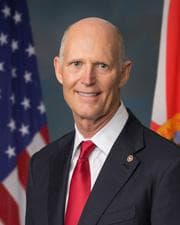

Rick Scott

Rick Scott

Republican · U.S. Senator for Florida

191 sponsored · 406 cosponsored

Age 74 · In office since 2019

Contact their office: (202) 224-5274 · 110 Hart Senate Office Building, Washington, DC 20510 · Official website

What they got done

Most bills never get a vote. These are the ones they wrote or backed that got somewhere.

Became law (7)

  • Joni Ernst (R-IA)

    Cosponsored

    Billion Dollar Boondoggle Act of 2025

    S. 766 Government Operations and Politics

    A Republican bill with 2 Democratic cosponsors.

    Became law

    This bill requires an annual report of taxpayer-funded projects that are over budget and behind schedule.

    Yes· 2 of 10

    • Scored +8

      Does this make what the government does easier for the public to see?

      The bill requires public disclosure of details regarding massive taxpayer-funded projects via the OMB website.

    • Scored +5

      Does this make the government pay for what it commits to?

      The bill promotes fiscal accountability by requiring reporting on projects that exceed budgets by $1 billion.

    No question was scored the opposite.

  • Susan Collins (R-ME)

    Cosponsored

    Kay Hagan Tick Reauthorization Act

    S. 2398 Health

    A Republican bill with 15 Democratic cosponsors.

    Became law

    This bill is designed to reauthorize specific programs related to vector-borne diseases. The legislation amends the Public Health Service Act to update the timeline for several provisions.

    Yes· 2 of 11

    • Scored +3

      Does this make the country readier for the next outbreak?

      The bill enhances support for health departments and regional centers that address vector-borne diseases, improving pandemic preparedness related to those diseases.

    • Scored +2

      Would children be better off under this?

      Preventing and treating vector-borne diseases has a small positive impact on children's health.

    No question was scored the opposite.

  • John Cornyn (R-TX)

    Cosponsored

    Holocaust Expropriated Art Recovery Act of 2025

    S. 1884 Law

    A Republican bill with 11 Democratic cosponsors.

    Became law

    This Act seeks to clarify and improve the existing 2016 Act. It aims to ensure that claims to recover Nazi-looted art are resolved on their actual merits rather than being dismissed due to various legal technicalities.

    Yes

    • Scored +7

      Does this protect the right to fair treatment by the courts?

      The bill enhances legal recourse for victims by precluding time-based and discretionary defenses.

    No question was scored the opposite.

And 4 more on their Sponsored and Cosponsored pages.

Passed Congress — the President's turn (1)

Both chambers passed it. The President signs it into law or vetoes it, and a veto stands unless two-thirds of each chamber vote to pass it anyway. Everything Congress has sent the President →

  • Rick Scott (R-FL)

    Their bill

    Veterans Accessibility Advisory Committee Act of 2025

    S. 1383 Government Operations and Politics

    A Republican bill with 2 Republican cosponsors. See the voting map.

    Passed both chambers

    218213

    This bill establishes strict requirements for voter registration and casting ballots in federal elections.

    Yes· 2 of 3

    • Scored +2

      Would people with disabilities be better off under this?

      The bill includes a provision requiring reasonable accommodations for individuals with disabilities to present proof of citizenship.

    • Scored +2

      Does this make what the government does easier for the public to see?

      The bill requires states to verify citizenship through the SAVE system to ensure voter rolls are accurate.

    The opposite· 2 of 8

    • Scored -5

      Does this make casting a ballot easier in practice?

      Mandating physical photo IDs for in-person voting and copies of IDs for mail-in voting increases the difficulty of casting a ballot.

    • Scored -4

      Does this protect the right to vote?

      The bill implements strict documentary proof of citizenship and photo ID requirements that create new hurdles for many voters.

Passed one chamber, waiting on the other (10)

Halfway: the other chamber has to pass the same text before it can go to the President.

  • Bill Cassidy (R-LA)

    Cosponsored

    Older Americans Act Reauthorization Act of 2025

    S. 2120 Social Welfare

    A Republican bill with 7 Democratic cosponsors.

    Passed the Senate

    With no one objecting, no names recorded

    Now: kept ready for the floor instead of being sent to a committee · Jul 15

    This Act aims to amend the Older Americans Act of 1965. It provides updated funding authorizations for fiscal years 2026 through 2030 across various aging-related programs.

    Yes· 2 of 12

    • Scored +10

      Would people over 65 be better off under this?

      The bill provides significant increased funding and services specifically for older individuals.

    • Scored +10

      Would retired people be better off under this?

      The core purpose of the bill is to support and enhance life for older adults and retirees.

    No question was scored the opposite.

  • Sheldon Whitehouse (D-RI)

    Cosponsored

    First Rhode Island Regiment Congressional Gold Medal Act

    S. 567 Armed Forces and National Security

    A Democratic bill with 25 Republican cosponsors.

    Passed the Senate

    With no one objecting, no names recorded

    Now: kept ready for the floor instead of being sent to a committee · Jun 15

    This bill orders the creation and presentation of a single Congressional Gold Medal to the First Rhode Island Regiment to honor their service during the Revolutionary War.

    Yes· 2 of 4

    • Scored +3

      Would veterans be better off under this, taking everything together?

      The bill honors the historical military service and sacrifice of veterans from the Revolutionary War.

    • Scored +3

      Would Black Americans be better off under this?

      The legislation explicitly recognizes and honors the significant contributions of soldiers of African heritage who served in the First Rhode Island Regiment during the Revolutionary War.

    No question was scored the opposite.

  • Deb Fischer (R-NE)

    Cosponsored

    North Platte Canteen Congressional Gold Medal Act

    S. 645 Armed Forces and National Security

    A Republican bill with 27 Democratic cosponsors.

    Passed the Senate

    With no one objecting, no names recorded

    Now: kept ready for the floor instead of being sent to a committee · Jun 9

    This Act authorizes the awarding of a Congressional Gold Medal to the individuals and communities who volunteered or donated to the North Platte Canteen in Nebraska during World War II.

    Yes· 2 of 4

    • Scored +5

      Would people in rural areas be better off under this?

      The bill honors a significant community-driven volunteer effort located in North Platte, Nebraska.

    • Scored +5

      Would veterans be better off under this, taking everything together?

      The bill honors the historical context of serving and supporting United States troops during World War II.

    No question was scored the opposite.

And 7 more on their Sponsored and Cosponsored pages.

Resolutions of theirs that were adopted (17)

A resolution is a chamber speaking for itself — a position, a rule or a tribute. Adopting it puts it into effect, but it is not a law.

Still waiting, of the 191 bills they wrote: 4 cleared committee and wait for a first vote, 169 are in committee. Committee is where most bills end, whoever writes them — silence there, not a vote, is the usual way a bill dies.

What their bills would do

Every bill is scored against plain yes-or-no questions. These count their bills — the ones they wrote and the ones they cosponsored — by how each question was answered: yes, or the opposite. Open one to see those bills, where each stands, and why it was scored that way. Scores are made by AI ().

Who their bills would affect

What else they would change

How they voted lately

Their latest votes that decided something, and what each measure would do.

  • U.S. Senate · Sep 29, 2026

    Protect College Sports Act of 2026

    The vote on whether to pass the bill This is the real decision in this chamber. Passing here sends the bill to the other chamber, which must pass it too before it can go to the President.

    Their vote Nay

    This bill sets national rules for student athlete name, image, and likeness rights. It creates protections for academic progress, medical coverage, and health and safety standards.

    • Scored +9

      Would people in their twenties and thirties be better off under this?

      Significantly expands earning potential through NIL rights and provides medical and academic protections for college athletes.

    • Scored -5

      Does this leave more decisions to the states?

      Prevents states from enforcing their own NIL compensation and transfer laws that conflict with the federal framework.

  • U.S. Senate · Sep 29, 2026

    To increase the limitation on funding for post-eligibility insurance and catastrophic injury for student athletes.

    A vote on a proposed change to the bill A vote on one change, not on the bill. A bill can collect dozens of these, and losing one does not stop it.

    Their vote Nay

    What the Amendment Does Mr. Booker, along with Mr. Blumenthal, submitted this amendment to change how a specific fund or program is paid for in the bill.

Every vote they cast, and how often they missed one →

On the President’s nominees

The President chooses federal judges, cabinet secretaries, ambassadors and military officers, and the Senate decides whether each one gets the job. Most are confirmed by voice vote, which records no one’s position. In the 119th Congress (2025–2026) the Senate put 224 confirmations to a recorded vote, and confirmed every one.

Their votes to confirm, of 224 recorded votes

  • Yes: 222
  • No: None
  • Missed: 2

Those votes covered 592 nominees, because the Senate sometimes confirms many in a single vote.

How busy they have been

How many bills they have put their name to over time — volume, not results: most bills never get a vote.

Legislative activity over time