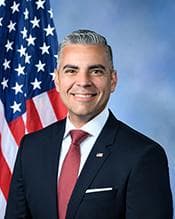

Juan Ciscomani

Juan Ciscomani

Republican · U.S. Representative for Arizona's 6th district

34 sponsored · 337 cosponsored

Age 44 · In office since 2023

Contact their office: (202) 225-2542 · 461 Cannon House Office Building, Washington, DC 20515 · Official website

What they got done

Most bills never get a vote. These are the ones they wrote or backed that got somewhere.

Became law (6)

  • Juan Ciscomani (R-AZ)

    Their bill

    Chiricahua National Park Act

    H.R. 6380 Public Lands and Natural Resources

    A Republican bill with 1 Democratic cosponsor.

    Became law

    This bill changes the name of the Chiricahua National Monument in Arizona to the Chiricahua National Park. The boundaries of the new park remain the same as the old monument's boundaries.

    Yes· 2 of 9

    • Scored +8

      Would Native Americans be better off under this?

      Provides explicit protections for cultural/religious sites and guarantees access for tribal members.

    • Scored +5

      Does this better protect public land such as parks and forests?

      Redesignates the area as a National Park and mandates the protection of cultural and religious sites.

    No question was scored the opposite.
  • David Valadao (R-CA)

    Cosponsored

    Romance Scam Prevention Act

    H.R. 2481 Commerce

    A Republican bill with 4 Democratic cosponsors.

    Became law

    This bill requires online dating service providers to send fraud ban notifications to members who have communicated with someone whose account was banned for fraud.

    Yes· 2 of 4

    • Scored +5

      Does this give people more protection from unfair business practices?

      The bill enhances consumer protection by requiring dating services to notify users of potential fraud risks.

    • Scored +3

      Does this protect people from AI fakes, scams and automated decisions about their lives?

      The bill protects individuals from scams by requiring dating service providers to send fraud ban notifications.

    The opposite

    • Scored -4

      Does this leave more decisions to the states?

      The bill restricts the ability of states and political subdivisions to maintain or enforce their own dating service notification standards.

  • Vince Fong (R-CA)

    Cosponsored

    Clergy Act

    H.R. 227 Social Welfare

    A Republican bill with 6 Democratic cosponsors. See the voting map.

    Became law

    The House voted 350–5 on Apr 27.

    This bill allows members of the clergy, members of religious orders, and Christian Science practitioners to revoke their previous exemption from Social Security coverage.

    Yes

    • Scored +3

      Would retired people be better off under this?

      By allowing clergy to join Social Security now, the bill provides them with potential income through monthly insurance benefits upon retirement.

    • Scored +3

      Does this strengthen Social Security?

      The act provides a mechanism for religious workers to access Social Security benefits that were previously unavailable due to their exemption.

    No question was scored the opposite.
And 3 more on their Sponsored and Cosponsored pages.

Passed one chamber, waiting on the other (47)

Halfway: the other chamber has to pass the same text before it can go to the President.

  • Juan Ciscomani (R-AZ)

    Their bill

    To designate the facility of the United States Postal Service located at 13355 North Lon Adams Road in Marana, Arizona, as the "Mayor Ed Honea Memorial Post Office".

    H.R. 6247 Government Operations and Politics

    A Republican bill with 3 Democratic cosponsors.

    Passed the House

    Since then: a Senate committee approved it and sent it to the floor

    Now: in the queue for a floor vote, with no date set · Sep 14

    This bill designates a specific United States Postal Service facility as the Mayor Ed Honea Memorial Post Office.

  • Juan Ciscomani (R-AZ)

    Their bill

    Pay Our Homeland Defenders Act

    H.R. 8029 Economics and Public Finance

    A Republican bill with no cosponsors. See the voting map.

    Passed the House

    218206

    Now: arrived in the other chamber; nothing has happened to it there yet · Apr 2

    This legislation provides funding for the Department of Homeland Security, the Coast Guard, and the Transportation Security Administration for the fiscal year ending September 30, 2026.

    Yes· 2 of 16

    • Scored +8

      Does this improve help for people hit by a disaster?

      The bill provides $26.3 billion for the Disaster Relief Fund to assist in major disasters.

    • Scored +5

      Would women be better off under this?

      The bill includes specific requirements to safeguard the health and rights of pregnant women in custody.

    The opposite

    • Scored -3

      Does this reduce what the federal government spends?

      The bill rescinds billions of dollars from various Department of Homeland Security accounts.

  • Juan Ciscomani (R-AZ)

    Their bill

    Critical Mineral Consistency Act of 2025

    H.R. 755 Energy

    A Republican bill with 6 Democratic cosponsors.

    Passed the House

    By voice vote, no names recorded

    Now: in the queue for a floor vote, with no date set · Mar 4

    This act aims to amend the Energy Act of 2020. The primary goal is to harmonize the lists of critical minerals and critical materials.

    Yes· 2 of 5

    • Scored +2

      Is this likely to grow the economy?

      Harmonizing critical mineral lists provides administrative clarity that can support resource-dependent industries.

    • Scored +1

      Would business owners be better off under this?

      Clarity on critical minerals can assist businesses involved in energy and resource sectors.

    No question was scored the opposite.

And 44 more on their Sponsored and Cosponsored pages.

Resolutions of theirs that were adopted (1)

A resolution is a chamber speaking for itself — a position, a rule or a tribute. Adopting it puts it into effect, but it is not a law.

Still waiting, of the 34 bills they wrote: 1 cleared committee and waits for a first vote, 23 are in committee. Committee is where most bills end, whoever writes them — silence there, not a vote, is the usual way a bill dies.

What their bills would do

Every bill is scored against plain yes-or-no questions. These count their bills — the ones they wrote and the ones they cosponsored — by how each question was answered: yes, or the opposite. Open one to see those bills, where each stands, and why it was scored that way. Scores are made by AI ().

Who their bills would affect

What else they would change

How they voted lately

Their latest votes that decided something, and what each measure would do.

  • U.S. House · Nov 12, 2026

    Major Richard Star Act

    The vote on whether to pass the bill This is the real decision in this chamber. Passing here sends the bill to the other chamber, which must pass it too before it can go to the President.

    Their vote Yea

    This bill changes the rules to allow certain military retirees to receive both veterans' disability compensation and retired pay at the same time.

    • Scored +8

      Would veterans be better off under this, taking everything together?

      This bill provides significant financial relief to veterans with combat-related disabilities by allowing them to receive both retired pay and disability compensation concurrently.

  • U.S. House · Nov 12, 2026

    Providing for consideration of the bill (H.R. 2102) to amend title 10, United States Code, to provide for concurrent receipt of veterans' disability compensation and retired pay for disability retirees with combat-related disabilities, and for other purposes.

    The vote on whether to adopt the resolution A resolution is one chamber speaking for itself — setting its own rules, taking a position, honouring someone — and it never goes to the President. Agreeing to it is the whole decision.

    Their vote Yea

    H. Res. 1247 sets the rules for how the House of Representatives will consider the bill H.R. 2102, which is also known as the "Major Richard Star Act."

    • Scored +7

      Would people with disabilities be better off under this?

      The bill provides increased financial compensation for service-connected disabilities.

  • U.S. House · Nov 11, 2026

    Retirement Fairness for Charities and Educational Institutions Act of 2025

    The vote on whether to pass the bill This is the real decision in this chamber. Passing here sends the bill to the other chamber, which must pass it too before it can go to the President.

    Their vote Yea

    This bill amends Federal securities laws to enhance 403(b) retirement plans. The changes affect laws such as the Investment Company Act of 1940, the Securities Act of 1933, and the Securities Exchange Act of 1934.

    • Scored +5

      Does this give people more protection from unfair business practices?

      The bill enhances consumer protection by establishing fiduciary responsibilities for employers managing 403(b) investment options.

Every vote they cast, and how often they missed one →

On the President’s vetoes

A vetoed bill becomes law only if two-thirds of both chambers pass it again. The President can refuse to sign a bill both chambers passed. It becomes law anyway only if two-thirds of the House and two-thirds of the Senate vote to pass it again. A vote against the veto (a Yea) was a vote to make the bill law over the President’s objection; a vote for it (a Nay) was a vote to let the veto stand.

How busy they have been

How many bills they have put their name to over time — volume, not results: most bills never get a vote.

Legislative activity over time