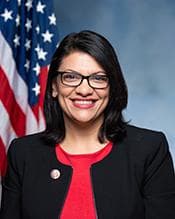


Rashida Tlaib

Rashida Tlaib

Democrat · U.S. Representative for Michigan's 12th district

52 sponsored · 1170 cosponsored

Age 50 · In office since 2019

Contact their office: (202) 225-5126 · 2438 Rayburn House Office Building, Washington, DC 20515 · Official website

What they got done

Most bills never get a vote. These are the ones they wrote or backed that got somewhere.

Became law (4)

  • Mike Quigley (D-IL)

    Cosponsored

    Accelerating Access to Critical Therapies for ALS Reauthorization Act of 2026

    H.R. 8205 Health

    A Democratic bill with 39 Republican cosponsors.

    Became law

    This bill extends the provisions and grants for ALS research found in the original Act through fiscal year 2031.

    Yes· 2 of 3

    • Scored +7

      Does this put more money into medical research?

      The bill extends the authorization of grants for ALS research through fiscal year 2031.

    • Scored +6

      Would people with disabilities be better off under this?

      The bill promotes research into therapies for ALS, a debilitating neurodegenerative disease.

    No question was scored the opposite.

  • Jimmy Panetta (D-CA)

    Cosponsored

    Lindsey O. Graham Sanctioning Russia and Iran Act of 2026

    H.R. 5334 International Affairs

    A Democratic bill with 5 Republican cosponsors. See the voting map.

    Became law

    The House voted 262–159 on Sep 16.

    This bill aims to crack down on the Russian Federation through heavy economic sanctions, investment bans, and increased import duties.

    Yes· 2 of 8

    • Scored +7

      Does this strengthen ties with allied countries?

      Coordinates sanctions with the G7, EU, and Five Eyes alliance.

    • Scored +6

      Does this send more money or help to other countries?

      Allows loans to Ukraine to be repaid using immobilized Russian sovereign assets.

    The opposite· 2 of 13

    • Scored -6

      Does this make trade with other countries easier?

      Imposes high tariffs on Russia and other countries facilitating sanctions evasion.

    • Scored -5

      Would billionaires be better off under this?

      Directly targets Russian oligarchs and high-net-worth individuals supporting the Russian government.

  • J. Hill (R-AR)

    Cosponsored

    21st Century ROAD to Housing Act

    H.R. 6644 Housing and Community Development

    A Republican bill with 16 Democratic cosponsors. See the voting map.

    Became law

    The House voted 358–32 on Jun 23.

    The 21st Century ROAD to Housing Act aims to increase housing supply and affordability across the United States.

    Yes· 2 of 51

    • Scored +10

      Would households on low incomes be better off under this?

      Extensive grants, vouchers, rent caps, and wealth-building pilots directly target low-income families.

    • Scored +10

      Would people in rural areas be better off under this?

      Extensive focus on rural housing preservation, USDA reforms, and rural credit union revitalization.

    The opposite· 2 of 6

    • Scored -8

      Would billionaires be better off under this?

      Directly targets and restricts large-scale corporate ownership of single-family homes.

    • Scored -7

      Would the very wealthiest people be better off under this?

      Imposes severe penalties on large institutional investors regarding single-family home ownership.

And 1 more on their Sponsored and Cosponsored pages.

Passed one chamber, waiting on the other (12)

Halfway: the other chamber has to pass the same text before it can go to the President.

  • Gus Bilirakis (R-FL)

    Cosponsored

    Major Richard Star Act

    H.R. 2102 Armed Forces and National Security

    A Republican bill with 207 Democratic cosponsors. See the voting map.

    Passed the House

    39218

    Now: handed to a committee to examine — Committee on Armed Services · Nov 12

    This bill changes the rules to allow certain military retirees to receive both veterans' disability compensation and retired pay at the same time.

    Yes· 2 of 3

    • Scored +8

      Would veterans be better off under this, taking everything together?

      This bill provides significant financial relief to veterans with combat-related disabilities by allowing them to receive both retired pay and disability compensation concurrently.

    • Scored +7

      Does this increase the pay, pensions or support veterans receive?

      The bill increases financial benefits for veterans with combat-related disabilities by allowing concurrent receipt of retired pay and disability compensation.

    No question was scored the opposite.

  • Tom Barrett (R-MI)

    Cosponsored

    To designate the facility of the United States Postal Service located at 117 West Lovett Street in Charlotte, Michigan, as the "Francis C. Flaherty Post Office Building".

    H.R. 9570 Government Operations and Politics

    A Republican bill with 6 Democratic cosponsors.

    Passed the House

    By voice vote, no names recorded

    Now: arrived in the other chamber; nothing has happened to it there yet · Sep 17

    This bill names a specific United States Postal Service facility after an individual. The building is located at 117 West Lovett Street in Charlotte, Michigan.

  • Gus Bilirakis (R-FL)

    Cosponsored

    AM Radio for Every Vehicle Act of 2025

    H.R. 979 Science, Technology, Communications

    A Republican bill with 158 Democratic cosponsors.

    Passed the House

    By voice vote, no names recorded

    Now: in the queue for a floor vote, with no date set · Sep 16

    This bill requires the Secretary of Transportation to issue a rule mandating that new passenger motor vehicles include access to AM broadcast stations as standard equipment.

    Yes· 2 of 6

    • Scored +4

      Does this improve help for people hit by a disaster?

      The bill enhances the effectiveness of emergency alert systems used during natural disasters.

    • Scored +3

      Would people in rural areas be better off under this?

      Ensuring AM radio access can be vital for emergency communications in rural areas.

    The opposite· 2 of 3

    • Scored -3

      Does this leave more decisions to the states?

      The bill explicitly prevents states from prescribing laws regarding AM radio access in vehicles.

    • Scored -2

      Would business owners be better off under this?

      The bill imposes new technical requirements and potential costs on automotive manufacturers.

And 9 more on their Sponsored and Cosponsored pages.

Still waiting, of the 52 bills they wrote: 50 are in committee, 2 were stopped. Committee is where most bills end, whoever writes them — silence there, not a vote, is the usual way a bill dies.

What their bills would do

Every bill is scored against plain yes-or-no questions. These count their bills — the ones they wrote and the ones they cosponsored — by how each question was answered: yes, or the opposite. Open one to see those bills, where each stands, and why it was scored that way. Scores are made by AI ().

Who their bills would affect

What else they would change

How they voted lately

Their latest votes that decided something, and what each measure would do.

  • U.S. House · Nov 12, 2026

    Major Richard Star Act

    The vote on whether to pass the bill This is the real decision in this chamber. Passing here sends the bill to the other chamber, which must pass it too before it can go to the President.

    Their vote Yea

    This bill changes the rules to allow certain military retirees to receive both veterans' disability compensation and retired pay at the same time.

    • Scored +8

      Would veterans be better off under this, taking everything together?

      This bill provides significant financial relief to veterans with combat-related disabilities by allowing them to receive both retired pay and disability compensation concurrently.

  • U.S. House · Nov 12, 2026

    Providing for consideration of the bill (H.R. 2102) to amend title 10, United States Code, to provide for concurrent receipt of veterans' disability compensation and retired pay for disability retirees with combat-related disabilities, and for other purposes.

    The vote on whether to adopt the resolution A resolution is one chamber speaking for itself — setting its own rules, taking a position, honouring someone — and it never goes to the President. Agreeing to it is the whole decision.

    Their vote Yea

    H. Res. 1247 sets the rules for how the House of Representatives will consider the bill H.R. 2102, which is also known as the "Major Richard Star Act."

    • Scored +7

      Would people with disabilities be better off under this?

      The bill provides increased financial compensation for service-connected disabilities.

  • U.S. House · Nov 11, 2026

    Retirement Fairness for Charities and Educational Institutions Act of 2025

    The vote on whether to pass the bill This is the real decision in this chamber. Passing here sends the bill to the other chamber, which must pass it too before it can go to the President.

    Their vote Nay

    This bill amends Federal securities laws to enhance 403(b) retirement plans. The changes affect laws such as the Investment Company Act of 1940, the Securities Act of 1933, and the Securities Exchange Act of 1934.

    • Scored +5

      Does this give people more protection from unfair business practices?

      The bill enhances consumer protection by establishing fiduciary responsibilities for employers managing 403(b) investment options.

Every vote they cast, and how often they missed one →

On the President’s vetoes

A vetoed bill becomes law only if two-thirds of both chambers pass it again. The President can refuse to sign a bill both chambers passed. It becomes law anyway only if two-thirds of the House and two-thirds of the Senate vote to pass it again. A vote against the veto (a Yea) was a vote to make the bill law over the President’s objection; a vote for it (a Nay) was a vote to let the veto stand.

How busy they have been

How many bills they have put their name to over time — volume, not results: most bills never get a vote.

Legislative activity over time