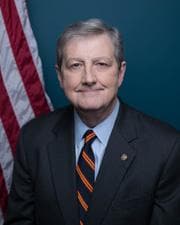

John Kennedy

John Kennedy

Republican · U.S. Senator for Louisiana

85 sponsored · 206 cosponsored

Age 75 · In office since 2017

Contact their office: (202) 224-4623 · 437 Russell Senate Office Building, Washington, DC 20510 · Official website

What they got done

Most bills never get a vote. These are the ones they wrote or backed that got somewhere.

Became law (7)

And 4 more on their Sponsored and Cosponsored pages.

Passed one chamber, waiting on the other (12)

Halfway: the other chamber has to pass the same text before it can go to the President.

  • John Kennedy (R-LA)

    Their bill

    Diversity Jurisdiction Inflation Adjustment Act

    S. 4850 Law

    A Republican bill with 3 Democratic cosponsors.

    Passed the Senate

    With no one objecting, no names recorded

    Now: kept ready for the floor instead of being sent to a committee · Aug 10

    This bill aims to amend title 28 of the United States Code. It seeks to adjust the thresholds used to determine jurisdiction. Specifically, it changes the amount required for a matter in controversy.

    The opposite

    • Scored -2

      Would workers who earn tips be better off under this?

      The bill increases the minimum amount in controversy required for diversity jurisdiction to $150,000, which may make it more difficult for workers to pursue certain claims in federal court.

    No question was scored yes.

  • David McCormick (R-PA)

    Cosponsored

    Terrorism Risk Insurance Program Reauthorization Act of 2026

    S. 4395 Finance and Financial Sector

    A Republican bill with 20 Democratic cosponsors.

    Passed the Senate

    With no one objecting, no names recorded

    Now: kept ready for the floor instead of being sent to a committee · Oct 5

    This bill extends the Terrorism Risk Insurance Act of 2002 by seven years. The new termination date for the program is changed from 2027 to 2034.

    Yes· 2 of 5

    • Scored +3

      Would business owners be better off under this?

      Business owners benefit from the extended availability and affordability of terrorism risk insurance coverage.

    • Scored +3

      Is this likely to grow the economy?

      Extending the Terrorism Risk Insurance Program provides stability and confidence for commercial real estate and business investments.

    No question was scored the opposite.

  • John Hoeven (R-ND)

    Cosponsored

    John A. Hauser Mental Health in Aviation Act

    S. 3257 Transportation and Public Works

    A Republican bill with 19 Democratic cosponsors.

    Passed the Senate

    With no one objecting, no names recorded

    Now: kept ready for the floor instead of being sent to a committee · Oct 1

    S. 3257, known as the John A. Hauser Mental Health in Aviation Act, directs the Federal Aviation Administration (FAA) Administrator to update regulations and guidance regarding individuals in aviation who disclose menta…

    Yes· 2 of 11

    • Scored +7

      Does this make mental health care easier to get?

      Encourages aviation personnel to seek mental health help and streamlines the medical certification process for those receiving treatment.

    • Scored +6

      Would people with disabilities be better off under this?

      Directly benefits those with mental health diagnoses by improving certification processes.

    The opposite

    • Scored -1

      Does this reduce what the federal government spends?

      The bill authorizes new spending of up to $16.5 million annually for medical examiners and public campaigns.

And 9 more on their Sponsored and Cosponsored pages.

Resolutions of theirs that were adopted (5)

A resolution is a chamber speaking for itself — a position, a rule or a tribute. Adopting it puts it into effect, but it is not a law.

Still waiting, of the 85 bills they wrote: 75 are in committee. Committee is where most bills end, whoever writes them — silence there, not a vote, is the usual way a bill dies.

What their bills would do

Every bill is scored against plain yes-or-no questions. These count their bills — the ones they wrote and the ones they cosponsored — by how each question was answered: yes, or the opposite. Open one to see those bills, where each stands, and why it was scored that way. Scores are made by AI ().

Who their bills would affect

What else they would change

How they voted lately

Their latest votes that decided something, and what each measure would do.

  • U.S. Senate · Sep 29, 2026

    Protect College Sports Act of 2026

    The vote on whether to pass the bill This is the real decision in this chamber. Passing here sends the bill to the other chamber, which must pass it too before it can go to the President.

    Their vote Yea

    This bill sets national rules for student athlete name, image, and likeness rights. It creates protections for academic progress, medical coverage, and health and safety standards.

    • Scored +9

      Would people in their twenties and thirties be better off under this?

      Significantly expands earning potential through NIL rights and provides medical and academic protections for college athletes.

    • Scored -5

      Does this leave more decisions to the states?

      Prevents states from enforcing their own NIL compensation and transfer laws that conflict with the federal framework.

  • U.S. Senate · Sep 29, 2026

    To increase the limitation on funding for post-eligibility insurance and catastrophic injury for student athletes.

    A vote on a proposed change to the bill A vote on one change, not on the bill. A bill can collect dozens of these, and losing one does not stop it.

    Their vote Nay

    What the Amendment Does Mr. Booker, along with Mr. Blumenthal, submitted this amendment to change how a specific fund or program is paid for in the bill.

Every vote they cast, and how often they missed one →

On the President’s nominees

The President chooses federal judges, cabinet secretaries, ambassadors and military officers, and the Senate decides whether each one gets the job. Most are confirmed by voice vote, which records no one’s position. In the 119th Congress (2025–2026) the Senate put 224 confirmations to a recorded vote, and confirmed every one.

Their votes to confirm, of 224 recorded votes

  • Yes: 218
  • No: None
  • Missed: 6

Those votes covered 588 nominees, because the Senate sometimes confirms many in a single vote.

How busy they have been

How many bills they have put their name to over time — volume, not results: most bills never get a vote.

Legislative activity over time
