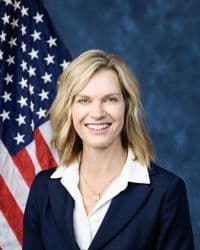

Julie Fedorchak

Julie Fedorchak

Republican · U.S. Representative for North Dakota

17 sponsored · 142 cosponsored

Age 58 · In office since 2025

Contact their office: (202) 225-2611 · 1607 Longworth House Office Building, Washington, DC 20515 · Official website

What they got done

Most bills never get a vote. These are the ones they wrote or backed that got somewhere.

Became law (3)

Passed one chamber, waiting on the other (24)

Halfway: the other chamber has to pass the same text before it can go to the President.

  • Julie Fedorchak (R-ND)

    Their bill

    High-Capacity Grid Act

    H.R. 6633 Energy

    A Republican bill with 4 Republican cosponsors.

    Passed the House

    By voice vote, no names recorded

    Now: handed to a committee to examine — Committee on Energy and Natural Resources · Sep 16

    This bill requires public utilities to use the best-available transmission conductor class for certain covered projects.

    Yes· 2 of 8

    • Scored +4

      Does this put more money into wind, solar and other renewable power?

      Facilitates better transmission capacity which supports the integration of renewable energy sources.

    • Scored +4

      Does this cut the pollution that drives climate change?

      Promotes high-efficiency transmission conductors that reduce energy loss and improve grid capacity for clean energy integration.

    No question was scored the opposite.

  • Julie Fedorchak (R-ND)

    Their bill

    To designate the facility of the United States Postal Service located at 840 Front Street in Casselton, North Dakota, as the "Commander Delbert Austin Olson Post Office".

    H.R. 1830 Government Operations and Politics

    A Republican bill with no cosponsors.

    Passed the House

    Since then: a Senate committee approved it and sent it to the floor

    Now: in the queue for a floor vote, with no date set · Sep 14

    This bill designates a specific United States Postal Service facility located at 840 Front Street in Casselton, North Dakota, as the Commander Delbert Austin Olson Post Office.

    Yes

    • Scored +2

      Would veterans be better off under this, taking everything together?

      Honors a Commander, which is a military rank, potentially benefiting the veteran community's recognition.

    • Scored +1

      Would people in rural areas be better off under this?

      Provides a named post office facility in the rural town of Casselton, North Dakota.

    No question was scored the opposite.

  • Julie Fedorchak (R-ND)

    Their bill

    North Dakota Trust Lands Completion Act of 2026

    H.R. 2252 Public Lands and Natural Resources

    A Republican bill with no cosponsors.

    Passed the House

    By voice vote, no names recorded

    Now: handed to a committee to examine — Committee on Energy and Natural Resources · May 20

    This bill allows the State of North Dakota to trade certain state land grant parcels for unappropriated Federal land.

    Yes· 2 of 10

    • Scored +6

      Would Native Americans be better off under this?

      The bill provides a mechanism for Indian Tribes to have State land grant parcels taken into trust for their benefit.

    • Scored +5

      Does this narrow racial gaps in how people are treated?

      The bill allows for the restoration of land to Indian Tribes by taking certain parcels into trust for their benefit.

    No question was scored the opposite.

And 21 more on their Sponsored and Cosponsored pages.

Still waiting, of the 17 bills they wrote: 12 are in committee. Committee is where most bills end, whoever writes them — silence there, not a vote, is the usual way a bill dies.

What their bills would do

Every bill is scored against plain yes-or-no questions. These count their bills — the ones they wrote and the ones they cosponsored — by how each question was answered: yes, or the opposite. Open one to see those bills, where each stands, and why it was scored that way. Scores are made by AI ().

Who their bills would affect

What else they would change

How they voted lately

Their latest votes that decided something, and what each measure would do.

  • U.S. House · Nov 12, 2026

    Major Richard Star Act

    The vote on whether to pass the bill This is the real decision in this chamber. Passing here sends the bill to the other chamber, which must pass it too before it can go to the President.

    Their vote Yea

    This bill changes the rules to allow certain military retirees to receive both veterans' disability compensation and retired pay at the same time.

    • Scored +8

      Would veterans be better off under this, taking everything together?

      This bill provides significant financial relief to veterans with combat-related disabilities by allowing them to receive both retired pay and disability compensation concurrently.

  • U.S. House · Nov 12, 2026

    Providing for consideration of the bill (H.R. 2102) to amend title 10, United States Code, to provide for concurrent receipt of veterans' disability compensation and retired pay for disability retirees with combat-related disabilities, and for other purposes.

    The vote on whether to adopt the resolution A resolution is one chamber speaking for itself — setting its own rules, taking a position, honouring someone — and it never goes to the President. Agreeing to it is the whole decision.

    Their vote Nay

    H. Res. 1247 sets the rules for how the House of Representatives will consider the bill H.R. 2102, which is also known as the "Major Richard Star Act."

    • Scored +7

      Would people with disabilities be better off under this?

      The bill provides increased financial compensation for service-connected disabilities.

  • U.S. House · Nov 11, 2026

    Retirement Fairness for Charities and Educational Institutions Act of 2025

    The vote on whether to pass the bill This is the real decision in this chamber. Passing here sends the bill to the other chamber, which must pass it too before it can go to the President.

    Their vote Yea

    This bill amends Federal securities laws to enhance 403(b) retirement plans. The changes affect laws such as the Investment Company Act of 1940, the Securities Act of 1933, and the Securities Exchange Act of 1934.

    • Scored +5

      Does this give people more protection from unfair business practices?

      The bill enhances consumer protection by establishing fiduciary responsibilities for employers managing 403(b) investment options.

Every vote they cast, and how often they missed one →

On the President’s vetoes

A vetoed bill becomes law only if two-thirds of both chambers pass it again. The President can refuse to sign a bill both chambers passed. It becomes law anyway only if two-thirds of the House and two-thirds of the Senate vote to pass it again. A vote against the veto (a Yea) was a vote to make the bill law over the President’s objection; a vote for it (a Nay) was a vote to let the veto stand.

How busy they have been

How many bills they have put their name to over time — volume, not results: most bills never get a vote.

Legislative activity over time