
A Republican bill with 7 Republican cosponsors · See all 7 cosponsors
Last activity — Referred to the House Committee on Energy and Commerce.
In committee
Introduced and handed to a committee in the chamber it started in.
The committee holds it, and most bills are never heard from again. A hearing or a committee vote would be news; silence is the usual outcome, and it kills the bill without anyone voting against it.
Its path through Congress
- Introduced
- In Committee
What this bill would do
The Fair Allocation of Interstate Rates Act seeks to change how costs are assigned for certain electric transmission facilities. It prohibits transmission providers from charging consumers in one state for the costs of a facility built to implement a specific policy in another state. This restriction applies unless the consumer's home state or a public official expressly consents to the cost allocation. The bill establishes a presumption that the benefits of these facilities belong solely to the people causing the costs. Finally, it requires the Commission to create rules to implement these changes within six months.
Yes· 3 of 4
- Scored +6
Does this leave more decisions to the states?
The bill enhances state sovereignty by requiring express consent from a state or its officials before its residents are charged for transmission projects driven by other states' policies.
- Scored +5
Does this give people more protection from unfair business practices?
The bill protects consumers from being charged for electric transmission facilities built to implement policies in other states without their state's consent.
- Scored +3
Would middle-income households be better off under this?
The bill prevents middle-income consumers from being forced to pay for energy infrastructure projects initiated by other states.
The opposite
- Scored -2
Does this reduce how much oil, gas and coal is produced?
By restricting how costs for new transmission facilities are allocated, the bill may make it more difficult to fund the infrastructure needed to implement state-level renewable energy policies.
- Scored -1
Does this improve buses, trains and other public transport?
The restriction on cost-sharing for electric transmission could potentially slow the development of integrated regional energy infrastructure.
Who it would affect, and how
Potential Positive Impacts for People
-
Prevention of Unconsented Cost Allocation: Under Section 2(h)(1), transmission providers would be prohibited from allocating costs for a "covered transmission facility" to consumers who are not residents of the state that implemented the policy driving the construction. This ensures people are not paying for projects requested by other states.
-
Protection of Non-Resident Consumers: According to Section 2(h)(3)(C), there is a presumption that a consumer residing outside the state that implemented a policy is not a "cost causer." This provides a layer of financial protection for residents in states that did not initiate the specific policy.
Potential Negative Impacts for People
-
Restricted Cost Sharing: Under Section 2(h)(1)(A) and (B), the ability to share costs across state lines for facilities built to implement a state policy is restricted. This could impact those who might have benefited from shared costs if the new rules were not in place.
-
Limited Exceptions to the Prohibition: Per Section 2(h)(2), the only way a consumer can be charged for these costs is if their specific State or a designated public official provides express consent. This creates a strict requirement for cost allocation that may not account for all circumstances.
Groups and Interests Ranking
Every group the model scored this bill for, from -10 to +10. Tap or hover a score for the reason it gave.
- Governance And Ideology
- Does this leave more decisions to the states? — The bill enhances state sovereignty by requiring express consent from a state or its officials before its residents are charged for transmission projects driven by other states' policies.
- Demographic And Interest Groups
- Would middle-income households be better off under this? — The bill prevents middle-income consumers from being forced to pay for energy infrastructure projects initiated by other states. Would people in rural areas be better off under this? — The bill protects residents from paying for out-of-state energy policies that may not directly serve their local needs.
- Economy And Finance
- Does this give people more protection from unfair business practices? — The bill protects consumers from being charged for electric transmission facilities built to implement policies in other states without their state's consent.
- Environment Energy And Infrastructure
- Does this reduce how much oil, gas and coal is produced? — By restricting how costs for new transmission facilities are allocated, the bill may make it more difficult to fund the infrastructure needed to implement state-level renewable energy policies. Does this improve buses, trains and other public transport? — The restriction on cost-sharing for electric transmission could potentially slow the development of integrated regional energy infrastructure.
- 3/26/2026
- 1 Cosponsor added.
- 1/9/2026
- 2 Cosponsors added.
- 12/17/2025
- 1 Cosponsor added.
- 12/9/2025
- 2 Cosponsors added.
- 12/1/2025
- Referred to the House Committee on Energy and Commerce.
- 1 Cosponsor added.
- Introduced in House
 Stephanie Bice
Republican · Oklahoma
 Andy Barr
Republican · Kentucky
 Dan Crenshaw
Republican · Texas
 Troy Downing
Republican · Montana
 Andy Harris
Republican · Maryland
 Abraham Hamadeh
Republican · Arizona
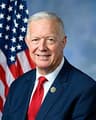 Randy Weber
Republican · Texas