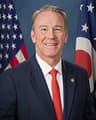
Jon Husted (R-OH)
A bill to amend the Help America Vote Act of 2002 to require voters to provide photo identification.
A Republican bill with 2 Republican cosponsors · See all 2 cosponsors
Last activity — Cloture on the motion to proceed to the measure not invoked in Senate by Yea-Nay Vote. 52 - 46. Record Vote Number: 231.
Introduced, nothing more yet
Formally proposed, and not yet handed to a committee.
Nearly every bill is sent to a committee within days. Introduction alone is not a sign of support, of momentum, or of any likelihood of passing — any member may introduce any bill.
Its path through Congress
- Introduced
How Congress voted
- See who voted how →A vote to end debate and allow a final vote · 08/08/2026
What this bill would do
This bill seeks to amend the Help America Vote Act of 2002 to implement photo identification requirements for federal elections. Individuals voting in person would be required to present a valid physical photo identification to receive a ballot. For those voting other than in person, the bill requires submitting a copy of a valid photo identification or providing specific details and an affidavit. The bill also establishes provisions for provisional ballots and provides access to digital imaging devices for making identification copies. Additionally, it mandates that states notify voters of these requirements during the registration process.
Yes· 3 of 6
- Scored +3
Does this give the federal government more power?
The bill mandates federal photo ID requirements for all federal elections.
- Scored +2
Does this protect the freedom to practise a religion?
The bill includes an affidavit option for those with religious objections to being photographed.
- Scored +2
Would Native Americans be better off under this?
The bill explicitly recognizes Tribal government identification as valid.
The opposite· 3 of 4
- Scored -3
Does this protect the right to vote?
The requirement of physical photo ID may create barriers to voting for certain demographics.
- Scored -3
Does this make casting a ballot easier in practice?
Strict photo ID requirements can restrict overall access to the ballot for some voters.
- Scored -3
Would households on low incomes be better off under this?
The cost and effort of obtaining photo ID can disproportionately impact low-income individuals.
What Congress actually voted on
One recorded vote has been taken on this bill.
- The Senate: a vote to end debate and allow a final vote In the Senate, debate can continue indefinitely unless 60 senators vote to end it. This vote is that attempt. It decides whether the Senate may vote on the thing at all — not whether the thing passes. A failed cloture vote usually ends the matter without anyone ever voting on its merits. Blocked 52 yes · 46 no
08/08/2026 · Roll call 231 · recorded as “On Cloture on the Motion to Proceed S. 5271”
Who it would affect, and how
Potential Positive Impacts for People
-
Access to Documentation Tools: State or local government officials must ensure public access to digital imaging devices, such as printers or scanners, at locations like libraries or courts so individuals can copy their identification at no cost (Section 1(a)(2)(B)).
-
Provisions for Religious Objections: Voters who do not have the required identification may use an affidavit if they have a religious objection to being photographed (Section 1(a)(1)(B)(i)(II)).
-
Alternative Verification for Non-In-Person Voting: Individuals voting other than in person may use the last four digits of their Social Security number along with an affidavit if they are unable to obtain a photo ID after reasonable efforts (Section 1(a)(2)(A)(ii)).
-
Protections for Specific Groups: The identification requirements do not apply to absent uniformed services voters or individuals granted specific voting rights under the Voting Accessibility for the Elderly and Handicapped Act (Section 1(a)(2)(B)).
Potential Negative Impacts for People
-
Mandatory Identification for In-Person Voting: Election officials may not provide a ballot for a federal election to an individual voting in person unless they present a valid physical photo identification (Section 1(a)(1)(A)).
-
Requirements for Non-In-Person Voting: Individuals voting other than in person must submit a copy of a valid photo identification or provide a Social Security number and an affidavit to have their ballot accepted (Section 1(a)(2)(A)).
-
Restrictions on Provisional Ballots: For a provisional ballot cast due to lack of identification to be considered eligible, the individual must present the required identification or a religious objection affidavit within 3 days (Section 1(a)(1)(B)(i)).
Groups and Interests Ranking
Every group the model scored this bill for, from -10 to +10. Tap or hover a score for the reason it gave.
- Social Issues And Justice
- Does this protect the freedom to practise a religion? — The bill includes an affidavit option for those with religious objections to being photographed. Does this make casting a ballot easier in practice? — Strict photo ID requirements can restrict overall access to the ballot for some voters. Does this protect the right to vote? — The requirement of physical photo ID may create barriers to voting for certain demographics.
- Demographic And Interest Groups
- Would Native Americans be better off under this? — The bill explicitly recognizes Tribal government identification as valid. Would people with disabilities be better off under this? — The bill includes provisions for those covered under the Voting Accessibility for the Elderly and Handicapped Act. Would veterans be better off under this, taking everything together? — Military identification is explicitly listed as an acceptable form of photo ID. Would households on low incomes be better off under this? — The cost and effort of obtaining photo ID can disproportionately impact low-income individuals.
- Governance And Ideology
- Does this give the federal government more power? — The bill mandates federal photo ID requirements for all federal elections. Does this make elections run better? — Proponents argue photo ID requirements improve election integrity and security. Does this leave more decisions to the states? — The bill imposes federal mandates on state-run election procedures.
- 8/8/2026
- Motion to proceed to consideration of measure made in Senate. (CR S4556)
- Cloture motion on the motion to proceed to the measure presented in Senate. (CR S4556)
- Cloture on the motion to proceed to the measure not invoked in Senate by Yea-Nay Vote. 52 - 46. Record Vote Number: 231.
- 8/7/2026
- 2 Cosponsors added.
- 8/6/2026
- Read the second time. Placed on Senate Legislative Calendar under General Orders. Calendar No. 547.
- 8/5/2026
- Introduced in the Senate. Read the first time. Placed on Senate Legislative Calendar under Read the First Time.
- Introduced in Senate
5 bills Congress.gov lists as related to this one — companions in the other chamber, earlier versions, and bills this one absorbed or was folded into.
- 119-HR-7300: Make Elections Great Again Act
- 119-HR-9368: Voter ID Act
- 119-S-1383: Veterans Accessibility Advisory Committee Act of 2025
- 119-S-4155: A bill to require voters to provide photo identification as a condition of casting a ballot, and for other purposes.
- 119-S-5505: Safe and Fair Elections Act of 2026
 Ashley Moody
Republican · Florida
 Dan Sullivan
Republican · Alaska