
A Republican bill with 2 Republican cosponsors · See all 2 cosponsors
Last activity — Referred to the Committee on Financial Services, and in addition to the Committees on Foreign Affairs, Energy and Commerce, Transportation and Infrastructure, Oversight and Government Reform, and Small Business, for a period to be subsequently determined by the Speaker, in each case for consideration of such provisions as fall within the jurisdiction of the committee concerned.
In committee
Introduced and handed to a committee in the chamber it started in.
The committee holds it, and most bills are never heard from again. A hearing or a committee vote would be news; silence is the usual outcome, and it kills the bill without anyone voting against it.
Its path through Congress
- Introduced
- In Committee
What this bill would do
The GAP Act aims to protect U.S. national security by strengthening the review of foreign adversary investments in the general aviation sector. It implements mandatory CFIUS filings for covered aviation transactions and extends jurisdiction over certain aviation real estate. The bill establishes a rebuttable presumption that acquisitions of general aviation companies by foreign adversaries should be prohibited. It also mandates a review of dual-use aviation technologies and requires outbound investment notifications. Additionally, the Act directs audits of supply chain integrity and restricts Federal financial assistance to specific entities.
Yes· 3 of 6
- Scored +2
Does this strengthen ties with allied countries?
The bill strengthens U.S. national security by limiting the influence of foreign adversary investments in strategic sectors.
- Scored +2
Does this make what the government does easier for the public to see?
The bill requires aviation companies to disclose foreign ownership in federal applications and production certificate filings.
- Scored +1
Would union members be better off under this?
The bill aims to protect the integrity of domestic aviation supply chains and manufacturing jobs.
The opposite
- Scored -4
Would business owners be better off under this?
The bill imposes new regulatory requirements, mandatory notifications, and potential financial clawbacks on aviation business owners.
- Scored -3
Does this make it easier to run a small business?
The bill introduces mandatory notifications and potential restrictions on federal financial assistance that may disproportionately burden smaller aviation entities.
Who it would affect, and how
Potential Positive Impacts for People
-
Enhanced National Security Protections: The bill seeks to prevent the transfer of critical technologies, such as advanced composite airframes and engine manufacturing expertise, to foreign adversary-controlled entities (Section 2).
-
Strengthened Aviation Supply Chains: By conducting supply chain integrity audits, the bill aims to ensure that avionics and engine control systems do not contain unauthorized components capable of remote access or interference (Section 8).
-
Increased Oversight of Strategic Real Estate: The expansion of jurisdiction ensures that aviation facilities near military installations or major airports are subject to stricter scrutiny (Section 3).
-
Protection of Dual-Use Technologies: The mandated review of technologies like high-efficiency engines and advanced avionics helps ensure these items are appropriately controlled for export (Section 5).
Potential Negative Impacts for People
-
Increased Regulatory Burdens on Aviation Entities: The bill introduces mandatory notifications for outbound investments and requires specific disclosures for FAA production certificate filings and Federal contract applications (Section 6; Section 9).
-
Restrictions on Federal Funding: Certain aviation businesses may be prohibited from receiving Federal loans, grants, or contracts if they are owned or controlled by a foreign person from a country of concern (Section 9).
-
Potential for Transactional Uncertainty: The use of a rebuttable presumption of prohibition for certain acquisitions creates a standard where the burden of proof rests on the acquirer to demonstrate that a transaction does not pose a risk (Section 4).
-
Financial Risks via Clawback Authority: Federal agencies are granted authority to recover financial assistance from entities that become subject to ownership prohibitions due to post-enactment changes in control (Section 9).
Groups and Interests Ranking
Every group the model scored this bill for, from -10 to +10. Tap or hover a score for the reason it gave.
- Demographic And Interest Groups
- Would union members be better off under this? — The bill aims to protect the integrity of domestic aviation supply chains and manufacturing jobs. Would business owners be better off under this? — The bill imposes new regulatory requirements, mandatory notifications, and potential financial clawbacks on aviation business owners.
- Economy And Finance
- Does this make it easier to run a small business? — The bill introduces mandatory notifications and potential restrictions on federal financial assistance that may disproportionately burden smaller aviation entities.
- National Security And Foreign Policy
- Does this strengthen ties with allied countries? — The bill strengthens U.S. national security by limiting the influence of foreign adversary investments in strategic sectors. Does this increase the pay, pensions or support veterans receive? — The bill protects the aviation-industrial base which supports various military and veteran-related logistical operations.
- Governance And Ideology
- Does this make what the government does easier for the public to see? — The bill requires aviation companies to disclose foreign ownership in federal applications and production certificate filings.
- Education And Technology
- Does this put more money into scientific research? — The bill indirectly supports domestic technological integrity by auditing and securing critical aviation supply chains.
- Environment Energy And Infrastructure
- Does this invest in rural communities? — The bill secures aviation infrastructure through stricter scrutiny of facilities near military installations.
- 7/23/2026
- 1 Cosponsor added.
- 7/15/2026
- Referred to the Committee on Financial Services, and in addition to the Committees on Foreign Affairs, Energy and Commerce, Transportation and Infrastructure, Oversight and Government Reform, and Small Business, for a period to be subsequently determined by the Speaker, in each case for consideration of such provisions as fall within the jurisdiction of the committee concerned.
- 1 Cosponsor added.
- Introduced in House
 Blake Moore
Republican · Utah
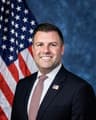 Ryan Mackenzie
Republican · Pennsylvania